< Page:Elementary Principles in Statistical Mechanics (1902).djvu
This page has been proofread, but needs to be validated.
OF THE ENERGIES OF A SYSTEM.
91
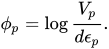
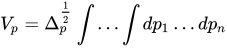
the integration being extended, with constant values of the coördinates, both internal and external, over all values of the momenta for which the kinetic energy is less than the limit . will evidently be a continuous increasing function of which vanishes and becomes infinite with . Let us set
The extension-in-velocity between any two limits of kinetic energy and may be represented by the integral
And in general, we may substitute for or in an -fold integral in which the coördinates are constant, reducing it to a simple integral, when the limits are expressed by the kinetic energy, and the other factor under the integral sign is a function of the kinetic energy, either alone or with quantities which are constant in the integration.
the limits of the integral being given by . That is, if
the limits of the integral for , are given by the equation
and the limits of the integral for , are given by the equation
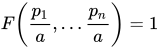
But since represents a quadratic function, this equation may be written


| (277) |


| (278) |


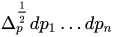
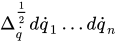

It is easy to express and in terms of . Since is function of the coördinates alone, we have by definition


| (279) |
| (280) |


| (281) |


| (282) |


| (283) |
This article is issued from Wikisource. The text is licensed under Creative Commons - Attribution - Sharealike. Additional terms may apply for the media files.