VOLTURNO—VOLUINSKY
207
in a small piece of soft iron, as in the case of the corresponding ammeters, and this in turn may be made to displace an indicating needle over a scale so that corresponding to every given potential difference between the terminals of the instrument there is a corresponding fixed position of the needle on the scale. One of the most useful forms of electromagnetic voltmeter is that generally known as a movable coil voltmeter (fig. 3). In this instrument there is a

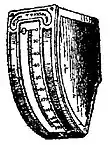
Fig. 4.—Edgewise Voltmeter, Stanley D'Arsonval type. movable coil voltmeters are much employed, generally constructed then in the "edgewise" pattern (fig. 4).
Electrodynamic Voltmeters.—A high-resistance electrodynamometer may be employed as a voltmeter. In this case both the fixed and movable circuits consist of fine wires, and the instrument is constructed and used in a manner similar to the Siemens dynamometer employed for measuring continuous alternating current (see Amperemeter). Another much-used method of measuring continuous current voltages of unidirectional potential difference employs the principle of potentiometer (q.v.). In this case a high-resistance wire is connected between the points of which the potential difference is required, and from some known fraction of this resistance wires are brought to an electrostatic voltmeter, or to a movable coil electromagnetic voltmeter, according as the voltage to be measured is alternating or continuous. This measurement is applicable to the measurement of high potentials, either alternating or continuous, provided that in the case of alternating currents the high resistance employed is wound non-inductively and an electrostatic voltmeter is used. The high-resistance wire should, moreover, be one having a negligible change of resistance with temperature. For this purpose it must be an alloy such as manganin or constantan. It is always an advantage, if possible, to employ an electrostatic voltmeter for measuring potential difference if it is necessary to keep the voltmeter permanently connected to the two points. Any form of electrokinetic voltmeter which involves the passage of a current through the wire necessitates the expenditure of energy to maintain this current and therefore involves cost of production. This amount may not by any means be an insignificant quantity. Consider, for instance, a hot-wire instrument, such as a Cardew's voltmeter. If the wire has a resistance of 300 ohms and is connected to two points differing in potential by 100 volts, the instrument passes a current of one-third of an ampere and takes up 33 watts in power. Since there arc 8760 hours in a year, if such an instrument were connected continuously to the circuit it would take up energy equal to 263,000 watt-hours, or 260 Board of Trade units per annum. If the cost of production of this energy was only one penny per unit, the working expenses of keeping such a voltmeter in connexion with a circuit would therefore be more than £l per annum, representing a capitalized value of, say, £10. Electrostatic instruments, however, take up no power and hence cost nothing for maintenance other than wear and tear of the instrument.
The qualities required in a good voltmeter are:—(i.) It should be quick in action, that is to say, the needle should come quickly to a position giving immediately the P.D. of the terminals of the instrument. (ii.) The instrument should give the same reading for the same P.D. whether this has been arrived at by increasing from a lower value or decreasing from a larger value; in other words, there should be no instrumental hysteresis. (iii.) The instrument should have no temperature correction; this is a good quality of electrostatic instruments, but in all voltmeters of the electrokinetic type which are wound with copper wire an increase of one degree centigrade in the average temperature of that wire alters the resistance by 0.4%, and therefore to the same extent alters the correctness of the indications. (iv.) It should, if possible, be available both for alternating and continuous currents. (v.) It should be portable and work in any position. (vi.) It should not be disturbed easily by external electric or magnetic fields. This last point is important in connexion with voltmeters used on the switchboards of electric generating stations, where relatively strong electric or magnetic fields may be present, due to strong currents passing through conductors near or on the board. It is therefore always necessary to check the readings of such an instrument in situ. Electrostatic voltmeters are also liable to have their indications disturbed by electrification of the glass cover of the instrument; this can be avoided by varnishing the glass with a semi-conducting varnish so as to prevent the location of electrostatic charges on the glass.
See J. A. Fleming, Handbook or the Electrical Laboratory and Testing-Room (London, 1903); G. Aspinall Parr, Electrical Engineering Measuring Instruments (London, 1903); K. Edgecumbe and F. Punga, "On Direct Reading Measuring Instruments for Switchboard Use," Journ. Inst. Elec. Eng. (London, 1904), 33, 620. (J. A. F.)
VOLTURNO (anc. Volturnus, from volvere, to roll), a river of central Italy, which rises in the neighbourhood of Alfedena in the central Apennines of Samnium, runs S. as far as Venafro, and then S.E. After a course of some 75 m. it receives, about 5 m. E. of Caiazzo, the Calore, only 3 m. less in length, which runs first N. and then W., and after 37 m. reaches Benevento, near which it receives several tributaries; then curves round the mountain mass to the N. of the Caudine Forks, and so beyond Telese joins the Volturno. The united stream now flows W.S.W. past Capua (anc. Casilinum), where the Via Appia and Latina joined just to the N. of the bridge over it, and so through the Campanian plain, with many windings, into the sea. The direct length of the lower course is about 31 m., so that the whole is slightly longer than that of the Liri, and its basin far larger. The river has always had considerable military importance, and the colony of Volturnum (no doubt preceded by an older port of Capua) was founded in 194 B.C. at its mouth on the S. bank by the Romans; it is now about one mile inland. A fort had already been placed there during the Roman siege of Capua, in order, with Puteoli, to serve for the provisioning of the army. Augustus placed a colony of veterans here. The Via Domitiana from Sinuessa to Puteoli crossed the river at this point, and some remains of the bridge are visible. The river was navigable as far as Capua.
On the 1st of October 1860 the Neapolitan forces were defeated on the S. bank of the Volturno, near S. Maria di Capua Vetere, by the Piedmontese and Garibaldi's troops, a defeat which led to the fall of Capua. (T. As.)
VOLUINSKY, ARTEMY PETROVICH (1689–1740), Russian general and statesman, son of Peter Voluinsky, one of the dignitaries at the court of Theodore III., came of an ancient family. He entered a dragoon regiment in 1704 and rose to the rank of captain; then, exchanging the military service for diplomacy, he was attached to the suite of Vice-Chancellor Shafirov. He was present during the campaign of the Pruth, shared Shafirov's captivity in the Seven Towers and in 1715 was sent by Peter the Great to Persia to promote Russian influence there, and if possible to find an outlet to India. In 1718 Peter made him one of his six adjutant-generals, and governor of Astrakhan. In this post Voluinsky displayed distinguished administrative and financial talents. In 1723 he married Alexandra Naruishkina, Peter's cousin. The same