< Flora of New York
| ← Brassicales |
Flora of New York — Santalales | → Caryophyllales 1 Droseraceae, Plumbaginaceae, Polygonaceae | |||
| Table of contents |
Genus index |
Protected species index | Invasive species index | ||
The Santalales is a largely parasitic order of plants. The only one of its families that is known to have native or naturalized members in New York is the Santalaceae.
Family Santalaceae
| The Santalaceae (sandalwood family) ...[1]
|
Comandra clade
| Also treated as the Comandraceae[1] (bastard-toadflax family), this group contains only the two species bastard toadflax (Comandra umbellata) and false toadflax (Geocaulon lividum), both of which are native to New York.
|
Comandra
|
|
| Comandra | Bastard-toadflax | N.Y. Status | Images | Distribution | NY NPT |
(L.) Nutt. ssp. umbellata 1753. Thesium umbellatum L. 1818. Comandra umbellata Nutt. 1905. Comandra richardsiana Fernald 1982. C. umbellata ssp. richardsiana Á&D.Löve |
Bastard toadflax | Native, Secure |
NYFA-5 USDA-NN NPT ARS ITIS Images, wsp | ||
Geocaulon
| Geocaulon | False-toadflax | N.Y. Status | Images | Distribution | NY NPT |
(Richardson) Fernald 1823. Comandra livida Richardson 1921. Geocaulon lividum Fernald |
False toadflax | Native, Endangered |
NYFA-1 USDA-NN ARS Images, wsp | ||
Cervantesia clade
| Also treated as the family Cervantesiaceae,[1] this is a group of parasitic flowering plants. Its only native or naturalized New York genus is Pyrularia.
|
Pyrularia
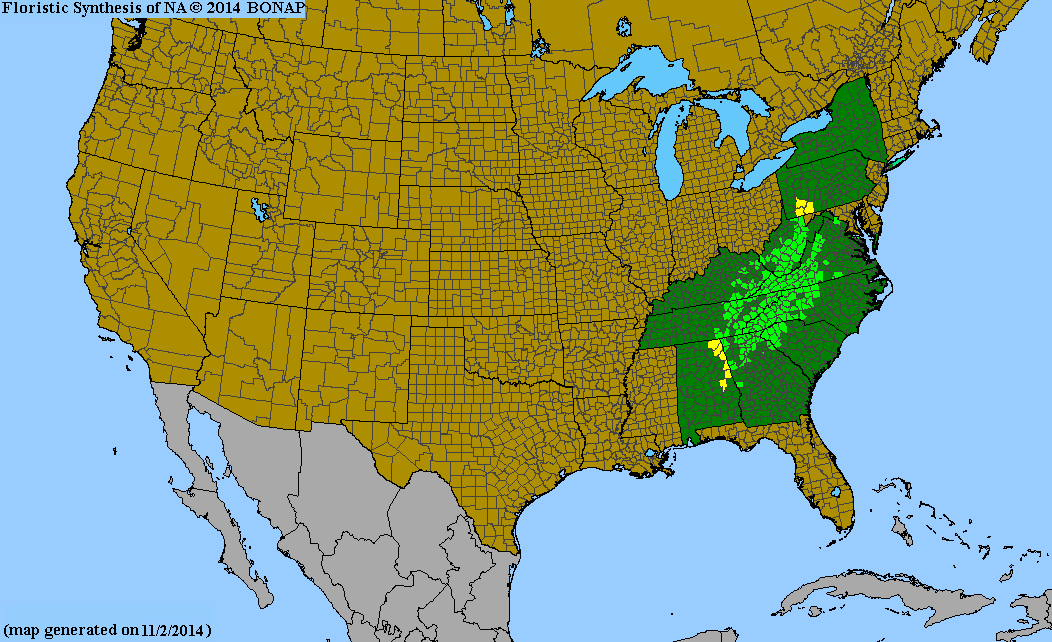
| Pyrularia contains two species native to the Himalayas of China and one native to the southeastern United States. Buffalonut (Pyrularia pubera) is a root-parasitic shrub, Native to the Appalachians and foothills from Southern Pennsylvania to Alabama and Georgia.[1] It appears to have naturalized on Long Island.
|
| Pyrularia | Buffalo-nut | N.Y. Status | Images | Distribution | NY NPT |
Michx. 1803. Pyrularia pubera Michx. |
Buffalo-nut, Oil-nut |
Introduced, US South native |
NYFA-Xm USDA-N0 ARS ITIS Trop. BNA Images, wsp | ||
Viscum clade
| Also treated as the family Viscaceae or tribe Visceae,[1] this group contains seven genera worldwide, two of which have single New York native species. These are branch parasites
|
Arceuthobium
| Arceuthobium pusillum or dwarf mistletoe parasitizes the branches of spruce, pine, and tamarack trees and is one of many causes for the deformations known as "witches brooms" seen on those trees.
|
| Arceuthobium | Dwarf-mistletoe | N.Y. Status | Images | Distribution | NY NPT |
Peck 1872. Arceuthobium pusillum Peck 1891. Razoumofskya pusilla Kuntze |
Dwarf mistletoe, Eastern dwarf-mistletoe |
Native, Vulnerable |
NYFA-3? USDA-NN NPT ARS ITIS Images, wsp | ||
Phoradendron
| American mistletoe (Phoradendron leucarpum) is believed to be native to Staten Island where it was reported growing on blackgum (Nyssa sylvatica) trees until sometime prior to 1879. It is now considered to be extirpated from New York State.
|
| Phoradendron | Mistletoe | N.Y. Status | Images | Distribution | NY NPT |
(Raf.) Reveal & M.C.Johnst. 1817. Viscum leucarpum Raf. [1]1820. Viscum serotinum Raf. 1911. non P. leucocarpum Pacz. 1957. P. serotinum M.C.Johnst. 1989. P. leucarpum Reveal & M.C.Johnst. |
American mistletoe, Oak mistletoe, Eastern mistletoe, Hairy mistletoe |
Native, Extirpated |
NYFA-Z USDA-N0 ARS Images, wsp | ||
| |||||
| ← Brassicales |
Flora of New York — Santalales | → Caryophyllales 1 Droseraceae, Plumbaginaceae, Polygonaceae | |||
| Table of contents |
Genus index |
Protected species index | Invasive species index | ||
This article is issued from Wikibooks. The text is licensed under Creative Commons - Attribution - Sharealike. Additional terms may apply for the media files.