Questions tagged [aristotle]

Aristotle was a Greek philosopher, famous for his prolific writings on a vast array of subjects, including logic, ethics, aesthetics, metaphysics, politics, and even the natural sciences. He is widely considered a "founding figure" in Western philosophy.

Aristotle (384 BC – 322 BC) was a philosopher in Ancient Greece, who studied under Plato. Many consider him to be one of the "founding figures" of the comprehensive system of modern Western philosophy.
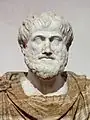
A marble bust of Aristotle

Modern research has estimated that he was responsible for writing over 150 philosophical treatises on a vast array of subjects, including logic, ethics, aesthetics, metaphysics, politics, and even the natural sciences like biology and physics. While many of his contributions to natural science were later roundly discredited, his writings on philosophy and metaphysics have shaped many centuries of later philosophical thought, from the Late Antiquity through the Renaissance, and even into modern times.

His prolific writings and wide range of interests conspire to make it exceptionally difficult to categorize or classify Aristotelian scholarship. Saint Thomas Aquinas, in fact, referred to him simply as "The Philosopher". However, all questions with this tag should have a direct relation to Aristotle's philosophical thought.

Also see: and

499 questions
38
votes
9 answers

Does happiness motivate every action?

Pascal wrote: All men seek happiness. This is without exception. Whatever different means they employ, they all tend to this end. The cause of some going to war, and of others avoiding it, is the same desire in both, attended with different views.…
26
votes
9 answers

Is infinite regress of causation possible? Is infinite regress of causation necessary?

For a number of reasons — including perhaps a desire to feel that we have a complete understanding of where we came from, or at least an understanding which is completely sufficient for all of our purposes — there is a strong tendency to suppose…
Niel de Beaudrap
  • 9,960
  • 4
  • 31
  • 52
25
votes
7 answers

Why is Aristotle's objection not considered a resolution to Zeno's paradox?

It seems to me, perhaps naïvely, that Aristotle resolved Zenos' famous paradoxes well, when he said that, Time is not composed of indivisible nows any more than any other magnitude is composed of indivisibles, and that Aquinas clarified the…
18
votes
2 answers

Why did the mid-19th century and earlier thinkers fixate on one-place predicates?

A book I'm reading mentions the following: A major barrier to the development of first-order logic had been the concentration on one-place predicates to the exclusion of many-place relational predicates. This fixation on one-place predicates had…
17
votes
4 answers

Is there any worth—other than historical—to reading Aristotle's works on logic?

What I mean is that presumably a topic such as logic would have, at this point, been so advanced that the ancestral works are unnecessary. I would read it for pleasure, but have they been ultimately rendered obsolete?
Sermo
  • 803
  • 5
  • 9
17
votes
1 answer

Are mathematical suppositions of physical theories determined uniquely according to Aristotle and Plato?

Does mathematics apply to physics in one way or multiple ways? What do Aristotle and Plato think? It would seem that Aristotle thinks mathematics can be applied to physics in one way only because, for him, mathematics is abstracted from physical…
16
votes
7 answers

Why would Aristotle argue that "a mechanic or a mercantile life" is "ignoble and inimical to virtue"?

All paid jobs absorb and degrade the mind. (Aristotle) UPDATE: As Michael notes below, a better translation of the above is in Rackham (reproduced from Michael's citation): This isn't a better translation as Michael is wrong about it being a…
15
votes
6 answers

Why is Russell so critical of Aristotle?

In A History of Western Philosophy, Russell argues: I conclude that the Aristotelian doctrines with which we have been concerned in this chapter are wholly false, with the exception of the formal theory of the syllogism, which is unimportant.…
amphibient
  • 1,438
  • 12
  • 23
15
votes
1 answer

Is transubstantiation faithfully Aristotelian?

Transubstantiation is a concept that Roman Catholic scholastics, most notably Thomas Aquinas, developed for the doctrine of Communion. Catholics state that when a priest blesses the elements of bread and wine, they become the body and blood of…
Mr. Bultitude
  • 279
  • 4
  • 13
15
votes
7 answers

Does science reject Aristotle's final cause?

To quote from the Stanford Encyclopedia of Philosophy: Here Aristotle recognizes four types of things that can be given in answer to a why-question: The material cause: “that out of which”, e.g., the bronze of a statue. The formal cause: “the…
15
votes
4 answers

What is the difference between Law of Excluded Middle and Law of Non Contradiction?

In spite of reading the SEP entry under Contradiction several times I have difficulty distinguishing between the two. We can translate the Aristotelian language, with some loss of faithfulness, into the standard modern propositional versions in…
user1207
14
votes
3 answers

Why were Kant's categories used in the mathematical category theory?

I am curious exactly how mathematical categories were inspired by Kant's categories. The SEP article on category theory says: In order to give a general definition of the [natural transformation], they defined functor, borrowing the term from…
14
votes
4 answers

Does Aristotle ever explicitly refer to man as a "rational animal"?

Did Aristotle every explicitly refer to man as a "rational animal" (ζῷον λόγον ἔχον)? The internet is riddled with uncited claims to this effect: that "rational animal" was an explicitly stated definition of man that Scholastic philosophy later…
brianpck
  • 242
  • 1
  • 2
  • 9
14
votes
3 answers

What can be skipped in Aristotle?

I plan on reading through some Aristotle, and I was wondering if there are any books by him that people consider a waste of time to read. I would like to read through everything eventually, but I know the Greek philosophers in particular can have…
Sketchyfish
  • 449
  • 3
  • 9
13
votes
5 answers

Do all epistemologies suffer from the "regress of justifications" problem?

Aristotle describes the regress problem in his logical work Posterior Analytics I.2: b5. Some hold that, owing to the necessity of knowing the primary premisses, there is no scientific knowledge. Others think there is, but that all truths are…
Geremia
  • 7,672
  • 2
  • 24
  • 52
1
2 3
33 34