Notice that the idea of certainty has been detached as a philosophical term in and of itself as treated, for instance, in Baron Reed's SEoP article Certainty relatively recently. Ancient philosophers designated the idea of certainty by expressions varying with how it was deemed in a given context. Thus, not surprisingly, there is a cluster of words and phrases that we would equivalently use the word 'certainty' or one out of its lexical kin. For example, in Plato's Euthyphro (5c-5d), Socrates' choice to express "to know for certain" is σαφῶς εἰδέναι (all the following original excerpts and their translations are from Loeb Classical Library):
καὶ ἐγώ τοι, ὦ φίλε ἑταῖρε, ταῦτα γιγνώσκων μαθητὴς ἐπιθυμῶ γενέσθαι
σός, εἰδὼς ὅτι καὶ ἄλλος πού τις καὶ ὁ Μέλητος οὗτος σὲ μὲν οὐδὲ δοκεῖ
ὁρᾶν, ἐμὲ δὲ οὕτως ὀξέως ἀτεχνῶς καὶ ῥᾳδίως κατεῖδεν ὥστε ἀσεβείας
ἐγράψατο. νῦν οὖν πρὸς Διὸς λέγε μοι ὃ νυνδὴ σαφῶς εἰδέναι
διισχυρίζου, ποῖόν τι τὸ εὐσεβὲς φῂς εἶναι καὶ τὸ ἀσεβὲς καὶ περὶ
φόνου καὶ περὶ τῶν ἄλλων;
And I, my dear friend, perceiving this, wish to become your pupil; for
I know that neither this fellow Meletus, nor anyone else, seems to
notice you at all, but he has seen through me so sharply and so easily
that he has indicted me for impiety. Now in the name of Zeus, tell me
what you just now asserted that you knew so well. What do you say
is the nature of piety and impiety, both in relation to murder and to
other things?
If we would attempt to approach through the etymological companion εἴδομαι, we might say, in one respect, what is known with certainty is taken as that what is seen clearly (σαφῶς).
I'd emphasise a word that stands out as the equivalent of many uses of certainty, including Wittgenstein's mentioned sense in particular, is βεβαιότης (with its lexical kin). Its adjective form is βέβαιος.
We cannot digress into Wittgenstein's Über Gewissheit (On Certainty), just to point to the relevant sense, we may note that a thread running throughout is the contrast between Weltanschauung which is, roughly, an interpretative frame, and Weltbild, which constitutes, again roughly, the normative steadfast grounds of our beliefs about the world. There is an the absence of all doubt as to the truth of our Weltbild. We hold to them without the slightest question. In this respect, certainty designates the quality of Weltbild.
So, here are two examples. The first one is from Plato's Phaedrus (277d-e): Socrates says
ὡς εἴτε Λυσίας ἤ τις ἄλλος πώποτε ἔγραψεν ἢ γράψει ἰδίᾳ ἢ δημοσίᾳ
νόμους τιθείς, σύγγραμμα πολιτικὸν γράφων καὶ μεγάλην τινὰ ἐν αὐτῷ
βεβαιότητα ἡγούμενος καὶ σαφήνειαν, οὕτω μὲν ὄνειδος τῷ γράφοντι, εἴτε
τίς φησιν εἴτε μή: τὸ γὰρ ἀγνοεῖν ὕπαρ τε καὶ ὄναρ δικαίων καὶ ἀδίκων
πέρι καὶ κακῶν καὶ ἀγαθῶν οὐκ ἐκφεύγει τῇ ἀληθείᾳ μὴ οὐκ ἐπονείδιστον
εἶναι, οὐδὲ ἂν ὁ πᾶς ὄχλος αὐτὸ ἐπαινέσῃ.
That if Lysias or anyone else ever wrote or ever shall write, in
private, or in public as lawgiver, a political document, and in
writing it believes that it possesses great certainty and clearness,
then it is a disgrace to the writer, whether anyone says so, or not.
For whether one be awake or asleep, ignorance of right and wrong and
good and bad is in truth inevitably a disgrace, even if the whole mob
applaud it.
The second one is from Aristotle's Metaphysics (4.1005b):
ὅτι μὲν οὖν τοῦ φιλοσόφου, καὶ τοῦ περὶ πάσης τῆς οὐσίας θεωροῦντος ᾗ
πέφυκεν, καὶ περὶ τῶν συλλογιστικῶν ἀρχῶν ἐστὶν ἐπισκέψασθαι, δῆλον:
προσήκει δὲ τὸν μάλιστα γνωρίζοντα περὶ ἕκαστον γένος ἔχειν λέγειν τὰς
βεβαιοτάτας ἀρχὰς τοῦ πράγματος, ὥστε καὶ τὸν περὶ τῶν ὄντων ᾗ ὄντα
τὰς πάντων βεβαιοτάτας.
Clearly then it is the function of the philosopher, i.e. the student
of the whole of reality in its essential nature, to investigate also
the principles of syllogistic reasoning. And it is proper for him who
best understands each class of subject to be able to state the most
certain principles of that subject; so that he who understands the
modes of Being qua Being should be able to state the most certain
principles of all things.
The privative form of βέβαιος is ἀβέβαιος. We see an exemplary usage of it with a probabilistic connotation in Sextus Empiricus' Outlines of Pyrrhonism:
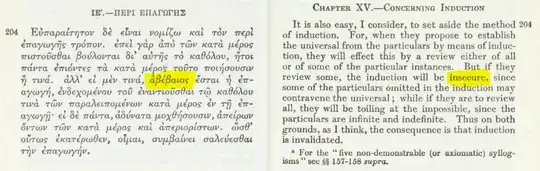
Hence, the induction will not be reliable (compare to "certain event") because of the possible contravention of the universal by some particular instances.


