1

The Stanford Encyclopedia of Philosophy in the article for happiness says:

In the face of these and other objections most commentators have concluded that neither happiness nor any other mental state can suffice for well-being.

https://plato.stanford.edu/entries/happiness/#DouAboValHap

"These objections" refer to the arguments that well being relies on non-mental conditions (exemplified by the Experience Machine thought experiment) and that a subjectively enjoyed life in impoverished conditions such as slavery are unsuitable for being well.

I'm deeply skeptical of the idea that well being is anything but mental based on my own life experience, and find the idea that well being is mental to be the most straightforward explanation of it, but am open to new arguments as always. Unfortunately, the given arguments in the article underwhelm me.

I'm very curious to hear whatever other families of objections exist which might persuade or enrich me. What might they be? Or do all other objections fall under the two "clusters" mentioned in the article?

  • 5
    [Mens sana in corpore sano](https://en.wikipedia.org/wiki/Mens_sana_in_corpore_sano) – Mauro ALLEGRANZA May 26 '22 at 10:07
  • 1
    Imagine someone who is malnourished, dirty, disease stricken, poorly clothed in a hazardous environment yet in a mental state of happiness and as such unwilling to change their condition. Doesn't that sound more like a drug addict than a person who is being well? I for one would not want to be in the place of such a person, however happy they might be at the moment and in spite of the fact that they are probably going to die happy. It appears well being is not only about being happy, but also the material conditions to make this happiness sustainable. – armand May 26 '22 at 11:21
  • That's the impoverishment objection. – QuestionAsker May 26 '22 at 11:28
  • It does seem to matter how we define "well being", colloquially to me "I am well" is synonymous with "I am happy". If we go on that definition and pick "happiness" suitably then perhaps we could say that the drug addict about to die is paradoxically "Well being". This might become more tractable if the OP picks a clearer bias/definition for "well". Formally I don't have any true definition of what "well" should mean, but its something worth pondering. – Sidharth Ghoshal May 26 '22 at 18:42
  • 1
    I've always wondered why there are not more hard solipsists. – BillOnne May 27 '22 at 01:32
  • 2
    Most philosophers distinguish between well-being and happiness. For them, happiness is a mental condition, but not the same as well-being or living well. Living well is not just a mental condition, but includes non-mental conditions such as not starving or addicted or imprisoned. This goes back to Aristotle, who thought Ethics was not just about what we call morality, but includes all the conditions necessary for a good life. – Ludwig V Oct 23 '22 at 16:24
  • 1
    I don't know about philosophy, but scientifically 'happiness' is subjective, without concrete criteria. When people say they are 'happy', what they really mean is that they're satisfied - their needs are being met. And scientifically, those needs are typically physical: good health, security, emotional, financial. So I think you could argue that 'happiness' has nothing to do with the mental at all, but rather it's a mental state that's achieved when we reach our preferred physical state of balance. – mcraenich Oct 28 '22 at 13:42
  • 1
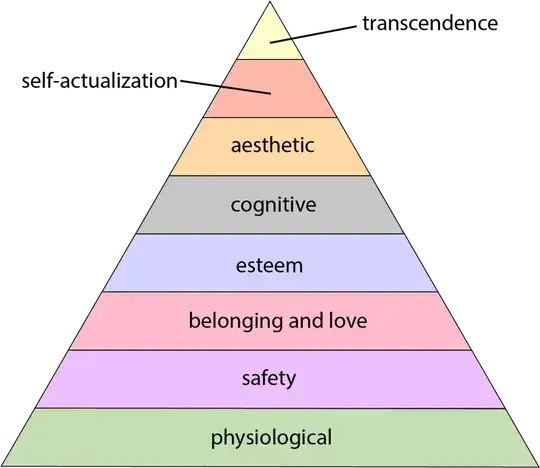
    Maslow's Hierarchy of Needs addresses the ways in which we need / desire different things in different circumstances. It is impossible to evaluate 'well-being' separate from *being*, which is oneself *in* the situation. – Scott Rowe Mar 26 '23 at 12:17

2 Answers2

1

So, you ask if the only clusters of thought about wellbeing, are that it's purely a material condition, or it's a purely mental condition?

You might consider game theory and the social contract: Is the tyrannicide perpetrated by William Tell morally legitimate?

And intersubjectivity: Studies exploring the rationale of gender equality

Attaining wellbeing, generally increases our capacities. Whatever goals we choose individually or together, increasing our capacities to do things, will likely help us attain them - although it may also give us existential threats like nuclear weapons.

Aristotle's eudaimonia is best translated as 'human flourishing', and we can understand this as accruing the capacities in our nature, towards being able to pursue our telos, our inwardly-directed goals. In this sense it is not a material condition, but about choosing our aims and finding satisfaction in attaining them. And doing so in regard to our inner nature, which through mechanisms of biology imbues us with aims which should, through surviving natural selection, secure our flourishing, and replication of those behaviours.

CriglCragl
  • 19,444
  • 4
  • 23
  • 65
  • To clarify, the two "clusters" in question are responses against the mental states concept of well being, i.e., non-mental requirements and impoverished happiness, not mental and material concepts of well being. – QuestionAsker May 26 '22 at 14:41
1

A physical condition of severe pain or hunger or thirst cannot be removed simply by wishful thinking yourself as out of pain or having eaten. It is simply impossible. Else we could go on living without satisfying basic needs, by simply thinking that they are satisfied.

These conditions must be physically removed.

Does this mean that a person is going to be happy when the pain is removed or after eating? If we take Maslow's hierarchy of needs as a valid observation (*), then no, not always. But this only makes clear that these physical conditions are necessary but not necessarily sufficient for happiness.

hierarchy of needs

(*) Above order of needs need not be universal. It is only necessary that people's happiness and well-being has multiple dimensions which all need be satisfied regardless if ordered this way or that way here or there.

Nikos M.
  • 2,113
  • 1
  • 11
  • 18