3

The advances in technology and the unprecedented levels of knowledge-sharing in the last few decades could be extrapolated to suggest that the human race as a whole will eventually converge to perhaps become a single people with a single language and culture, sharing the same system, and possibly generating very similar life experiences for each person. While there are obvious advantages to this, how would this homogeneity affect human knowledge as a whole?

Does human knowledge perhaps need disparate cultures and systems to generate unique lines of thought? Is a chaotic system of generating human knowledge better than a uniform one? (Or will our new ability to better store our collective knowledge perhaps offset any drawbacks?)

Frank Hubeny
  • 19,136
  • 7
  • 28
  • 89
coleopterist
  • 686
  • 2
  • 6
  • 18
  • 2
    Can you unpack this a bit more? What might you be expecting in an answer? What have you found out so far? – Joseph Weissman Jan 21 '13 at 16:34
  • 1
    the processes of scientific inquiry have been carefully crafted to transcend cultural biases and the variety of individual experience, so I don't know why you'd be inclined to think advancement of knowledge would depend on them. – Matthew Plourde Jan 21 '13 at 21:15
  • 1
    This question is too broad to generate a short answer that is typically appreciated in this site. Is it not a platitude which diversity brings creativity to the scientific's hypotheses? – Annotations Jan 23 '13 at 13:24
  • @JosephWeissman I've honestly been trying to see how I can "unpack" my question further and don't really see how. I could perhaps point to immigration policies and cosmopolitan societies, but I think that this is self-evident. I'm looking for opinions on my primary question on whether homogeneity will hinder the progress of human knowledge and why. I haven't really found out anything so far. – coleopterist Jan 24 '13 at 19:44
  • @RicardoBevilaqua Wouldn't that platitude then be at odds with Matthew's contention above? – coleopterist Jan 24 '13 at 19:44
  • What might have made this an urgent or important concern for you? – Joseph Weissman Jan 24 '13 at 19:57
  • @JosephWeissman It is neither. It is simply a question that arose while reading about the convergence of language. – coleopterist Jan 24 '13 at 20:02
  • If it's neither an urgent or important concern, can you at least speak to how it might have arisen during your studies? What makes this concern *interesting* to you, philosophically? – Joseph Weissman Jan 24 '13 at 21:04
  • @coleopterist There isn't a contractition with Matthew's contention. Creative search for hypotheses is different of justification of hypotheses. – Annotations Jan 24 '13 at 21:41
  • 1
    To me it sometimes surprising how *similar* human cultures were in some respects already in distant pasts (see e.g. [here](http://history.stackexchange.com/questions/5868) on Axial Age). – Drux Jan 25 '13 at 00:10
  • You don't learn knowledge. You learn experiences. – Tyler Langan Jan 26 '13 at 01:30
  • It is an interesting question but your assumption that we are really going toward a homogeneous culture has actually never been properly demonstrated. To do so, I thought to limit the investigation to "scientific knowledge" and to base the research on university textbooks for natural sciences. In principle I can compare all of them as they are circulating in a specific temporal instant and, I suppose, I would find a good degree of similarity. But your assumption contains another important aspect, namely, that homogenization of knowledge is a dynamic and therefore historical process. I agree wi – Spherical Jan 04 '19 at 13:21
  • Humans cannot. Transhumans can. If humans could, we would have already. Unfortunately our brains are tuned to tribes of maximally 150 individuals, and we generate more culture and sub-culture than can be spread in the same timespan. No one knows how many subcultures there is, because they pop up faster than you can count them. – Kile Kasmir Asmussen Jan 27 '13 at 17:01
  • Any system becomes a thesis which, inevitably, creates its own antithesis, thus continuing the dialectical process. So the mixing of many cultures and points of view does not lead to a meanings mushy soup but rather a richer source of new theses, which can keep the process alive. So, somewhat as the world views of women, of cultural minorities, and of differing orientations enriches a culture, so the world-wide interplay of knowledges (there's not just one) make for an exciting, if not simple, future. – user2086 Jan 23 '13 at 03:55
  • Within any culture, there are subcultures. The kind of uniformity you are looking toward does not happen even in very conformist cultures. Those cultures produce subcultures that directly challenge the rules. Look at Japan. It is notoriously conformist and peaceful, but it has a violent pedophile sex industry, television programs that spy on people in their bathrooms, a thriving underground illegal gambling culture, a world-renowned Mafia... Those things dissipate in historical periods when the culture gets less conformist. –  Jan 04 '19 at 16:14
  • A couple of well-known ideas pop to mind - they indicate/point to an ancient dilemma that will in all likelihood come to a head in the coming 50 - 100 years, assuming it hasn't already. Perhaps the problem can be simplified, sacrificing truth in the process, to two disciplines/subjects/fields which seem to be performing some kinda complex maneuver that would require humanity's best brains to grasp and ... what else do we like to do? – Agent Smith Jun 18 '23 at 05:12

2 Answers2

1

I would say the assumptions here are wrong-headed in several ways. Homonid speciation, was driven by isolation related to climate conditions. And when they reconnected, they interbred.
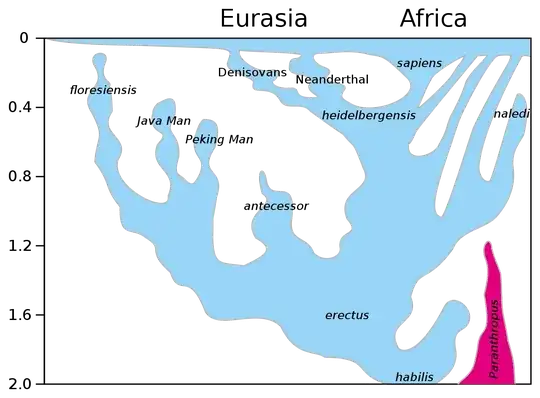
Evolution of the genus homo, from Human Evolution page on Wikipedia From Human Evolution: Evolution of the genus homo on Wikipedia.

There are some more maps and discussion relating to the convergence of the hominid species here: Can you explain clearly the difference between race and ethnicity? Humans are an exceptionally undiverse species, because of the small population after the Toba bottleneck, and limited admixture (3-5% of genes) from other hominid species. There is less variation among all humans, than within some specific breeds of dog. Skin colour is only controlled by about ten genes, and skin albedo of indigenous populations closely follows a map of humidity, and this has tended to confound our ideas about how much we vary.

The thing about speciation, is it's not a one-way street. In good times sure, homogeneity increases. But a lot of evolution is driven by punctuations in the equilibrium, like Ice Ages, mass-extinctions, volcanic eruptions. And, we are just at the beginning of a climate roller-coaster, with few indications of mitigation. 50% of species have been lost in the last century, the majority of those in the last 50 years, and the pace is accelerating. There are unknown factors like Siberian permafrost & oceanic methane-hydrate methane release, and weakening of the Gulf Stream, which could plausibly trigger huge migrations related to rising sea-levels, drought, and an unlivable mix of heat and humidity in many regions.

Failure to effectively deal with mass migrations is linked to the Fall of Rome in the Migration Period. The recent Syrian War was triggered partly by drought with no government relief, giving a sense of how conflicts may rise. We assume progress will keep marching forwards, but that ignores the record of civilisational collapse. Previous examples have not resulted in homo sapiens speciating. But now we have nuclear weapons, which could result in a multi-year Nuclear Winter, which would really radically challenge our species.

Going to Mars, will see a group of humans there face dramatically different selection conditions, like low gravity and high solar radiation, as well as substantial physical isolation, which could easily be made more complete by widespread war and civilisational collapse on Earth. A recipe for a new species to emerge.

A final point to consider is horizontal gene transfer. You might consider humans as the species that perfected 'horizontal meme transfer', mimicing cave bear claws with handaxes, persistence hunting like wolves, and wearing flippers like fish. We will also doubtless be initiating a new era, of genetic and phenotypic plasticity from intentional horizontal gene transfer, and fabrication. Our ability to do this safely is currently limited, but quantum computing is perfect for doing protein-folding calculations, which will greatly help. We might choose to create new human species, or to mix with other species.

On the more general question, is homogenisation bad?

Having variety when a collapse hits, can help at least some to survive, and it's hard to know what traits could become pivotal. Travel, and media, have tended to increasingly limit the scope cultural variation (see discussion of some changes here: Is physical attractiveness subjective?).

There are estimates that every 40 days a language dies, and language death is an accelerating phenomenon, while the fact most computer coding requires some knowledge of English, is further pushing an already widespread language as a dominant second-language. There has historically been hostility to minority languages, but the resurgence of Welsh, Irish Gaelic, and Hawaiian, are indicative of how that is changing. I would look to the impact of relearning of Ancient Greek on the Western Holy Roman Empire (luckily preserved elsewhere), the accessing of climate data from Australian Aborigine oral traditions, and what would have happened without discovering the Rosetta Stone, as examples of how losing languages could mean permanent loss of information. Losing a language tends to relate to losing a culture and it's traditions, to losing a way of seeing and relating to the world. I don't think we should be embracing homogeneity, but instead celebrating diversity.

The different cultural practices of different groups, who are in various competitions and contentions, has been a major driver of social progress. Interesting examples are, the emergence of Ancient Athenian Democracy, and the codifying of habeus corpus. I would contend that these far-reaching social technologies, provided lasting benefits to the societies that developed them and were inspired by them. We need groups trying out new ways to live and organise. But we also need the ones that suceed, to be able to transmit their new way - and while we hope that will be through soft-power, the real backstop is hard-power. NATO has codified community standards that benefit members, without reducing their autonomy, and that kind of alliance that sustains difference fortunately seems to have overtaken cultural imperialism, which China and Russia seem intent on keeping alive, but in a global minority doing so.

CriglCragl
  • 19,444
  • 4
  • 23
  • 65
0

I offer my opinion. In that we will eventually homogenize as a race. But we do not know where knowledge ends. It perhaps could be anticipated that the life experience will become predictable and limited to a specific number of directions. And this actually resembles the lives of animals.

Right now we live inside a bubble of discovery in physics and physiology, but animals live inside a world of nature. Nature is their limitation and perhaps eventually will be ours too. What if we discover how to live inside a virtual world that has no material possessions or necessities? Or even more outlandish, a world where the mind controls all the needs. Then this man made reality becomes obsolete and our evolution might resemble some alien who can transport themselves through the world or universe. This sounds like fantasy but I compare it to how science only discovers what is alreaady in nature. And if life is solipsistic we might already be some floating rock in space with an antennae on our head imagining all this. Good morning!

Robus
  • 332
  • 2
  • 9
  • 1
    I'd rather say that we will not homogenise until we have established the limits of knowledge, and this won't happen until more people become interested in metaphysics and the possibilities of experience. If we stick rigidly to scientific research then there'll never be a reason for us to give up our metaphysical opinions and they'll vary forever as they do now. If philosophers cannot agree then the same will go for the rest of us and we'll all go our own way. –  Feb 04 '19 at 12:26