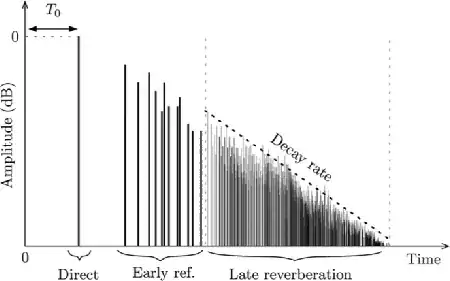
When speaking in terms of reverb, how long do early reflections take to occur/become audible after the direct sound?
in addition to the other answers, this also depends on the decay time of the original sound. A long decay time means the direct sound can be louder than the early reflections.
E.g. a single clap will generate audible reflections sooner than a piano tone with the Sustain pedal pressed. Although this depends on the exact decay characteristics of the instrument. In the graph in the question, a slope is drawn for the decay rate of the room. You can draw a similar slope for the decay rate of the instrument. If this is steeper than the room decay rate, you could hear the reflections over the original sound.
Also, do early reflections dictate if a space is long/short or does it also dictate if a room is high/short and/or wide/narrow?
The reflection time says something about all 3 dimensions of the room, but can't distinguish between them. Although the first reflection will generally be straight off the back wall. Later reflections will have bounced off 2 or more walls.
and lastly, why are early reflections more spaced out than late reflections? As shown in the image below.
The direct sound travels more or less as a sphere from its point of origin. When the sphere intersects a wall, it'll create a whole series of reflections all along the wall, smearing out the signal.
For the late reflections, the sound has had time to bounce around multiple times, getting more smeared out each time.