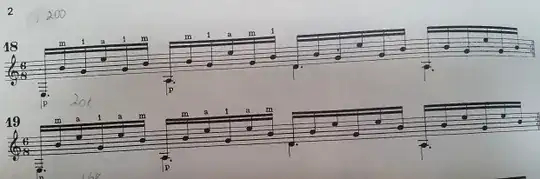
The first edition (published 1852) had staccatissimo dashes on the first two bars, not staccato dots. You can find it on IMSLP.
Old music editions usually assume that the performer had some musical common sense, and in this case (as you guessed) that means the articulations apply until either the music changes or there is an instruction to stop playing them. Sometime the notation "sim." or "simile" was used instead of cluttering the score with repetitive markings.
The Peters edition (published 1903) changed the dashes to staccato dots and repeats them on all the chords. That was clearly not done with Burgmüller's approval, since he had died 25 years earlier.
The editor/publisher of the other edition you found on line presumably decided that Burgmüller made a mistake marking these chords staccatissimo (and the Peters edition editor was also wrong) and he really meant marcato (which what I assume you mean by "downward arrows").
The general take-home lesson here is that finding out what a composer actually wrote, rather than what some music publisher thought he should have written, often requires a bit of research. https://imslp.org is an excellent resource for comparing editions of music that is out of copyright, like these studies.