For example, Em(onD) and Em(onC♯). I found these in a Japanese guitar tab book I bought.
Asked
Active
Viewed 836 times


4 Answers
9
As @NReilingh says, it's probably a Japanese alternative to "slash notation".
"C/B" for example -- often read aloud as "C over B" means a C chord played over a prominent B bass note.
The easy way to play these is to have a bassist! You play a normal C, the bassist plays the B.
Without a bassist, you need to sound the bass note yourself. For example, to play G/F# you might use the 2nd fret of the bottom E string, instead of the 3rd fret you'd normally use.

slim
- 35,926
- 8
- 94
- 154
4
It's probably a shorthand for slash notation. Try putting the "on" note in the bass below whatever other chord is notated.

NReilingh
- 34,804
- 6
- 102
- 169
-
You're speaking to me like I have a clue what I'm doing :) I just recently took up playing guitar. Although maybe it would be better to open up a separate question where this slash notation can be described in more detail and link to that from here so it can hopefully be found easier by searching. – Sam Jul 09 '12 at 13:56
-
To be fair, you asked the original question like you had a clue what you were doing! The other answers have elaborated fully. – NReilingh Jul 10 '12 at 03:38
3
Don't let the term "slash notation" bother you. It's simply a chord that has a bass note(the lowest note) that is not normally part of the chord. You find a lot of these chords in songs by The Beatles for instance.
While you are learning and so new at guitar, I suggest using songbooks that have chord diagrams each time you need to play the chord. In time, you won't need any help remembering the chords.

B0nk3r
- 329
- 1
- 4
2
In addition to slim and NReilingh's answers:
Usually when you see a chord, the lowest note played is the root note of the chord. So when you normally see a chord marked as Cm that means play a C minor chord with the lowest note (the bass note) as the root -- C: C, E♭, G.
Normally you play the chord going up. So in the Cm example, you play the root C, the third E♭, and the fifth G:

Musicians like playing around with something called "inversions" of a chord, where you change the ordering of the notes. Normally first inversion is where the second note (which in our example is the third degree of the scale) is played first: E♭, G, C. The C is played higher on the instrument than before:
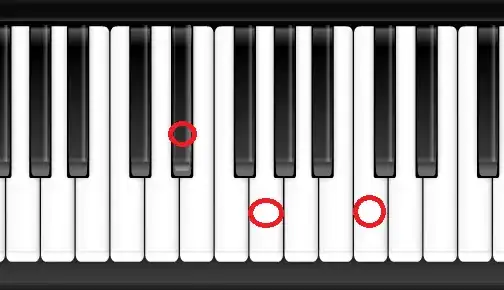
In the same way, we have second inversion, which is where the fifth degree of the scale is played first:
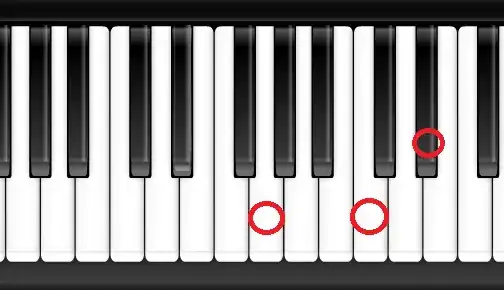
So what the others were saying follows this logic. You should probably play an Em with the lowest note being a D for the Em(on D) [Em/D]. This can be done in many ways!
For the Em(onC#) [Em/C#], look here for ways to play that.
Hope this helps!

Ulf Åkerstedt
- 6,783
- 4
- 27
- 52

rishimaharaj
- 1,269
- 11
- 22
-
1This isn't an inversion. There's no `C♯` or `D` in Em (`E - G - B`). – American Luke Jul 09 '12 at 19:55
-
@Luke, correct, but understanding inversions can help with understanding the *why* behind slash notation. – rishimaharaj Jul 10 '12 at 01:02