1

I know that when a key signature has sharps, the major key indicated is always one half step above the last sharp in the key signature.

For example, the key of D Major has two sharps -- F# and C#, in that order -- D is one half step higher than the last sharp.

Can anyone give me a similar easy rule that works with flat key signatures?

Aaron
  • 70,616
  • 10
  • 97
  • 243
Pigion Li 391
  • 41
  • 1
  • 5
  • To find the name of a key signature with sharps, look at the sharp farthest to the right. The key signature is the note a half step above that last sharp. Key signatures can specify major or minor keys. To determine the name of a minor key, find the name of the key in major and then count backwards three half steps. – Pigion Li 391 Sep 21 '17 at 10:45
  • @Care Witthoft -very faint possibility, but not really a dupe. And how obvious to someone who doesn't understand? – Tim Sep 21 '17 at 11:20
  • 1
    This is a legitimate question that doesn't seem to have an answer on this site. It's just worded very poorly. The question should be, "How do I determine what key a piece is in, given the key signature?". OP has answered half of this in his comment. Remember, SE is supposed to be a repository of answers, like a question-driven Wikipedia. And it's actually entirely valid to ask a question and answer it yourself. – MattPutnam Sep 21 '17 at 17:12
  • @MattPutnam - of course it's entirely valid, but it's exactly what the OP didn't do. I can't understand why that comment was made. True, a poorly worded question. In need of an edit? – Tim Sep 21 '17 at 19:23
  • @Tim I considered editing, but that would involve completely rewriting it, and that seems against the spirit of the site. But either we should do that, or delete this and I'll repost it worded better (and answer it myself). I actually think it's a really great question that deserves a solid answer on here. – MattPutnam Sep 21 '17 at 22:20
  • Hey, guys, can we try to be a little more friendly to the poor person who asked this question, who clearly is new here and is trying to contribute? All of the things you note about this question are true, but there are so many more thoughtful ways to make them clear. We all start somewhere, and there is nothing *malicious* or ill-intended about this question. There's no need to get snappy here. – General Nuisance Sep 21 '17 at 23:26
  • Pigion -- Thank you for your contribution to this site! This should answer your question: https://music.stackexchange.com/a/54011/27335 I will repost some of it in an answer here. – General Nuisance Sep 21 '17 at 23:31
  • 1
    @GeneralNuisance - does it seem odd that a question is posed, and an answer to an almost identical question is posted in the comments? No-one has been impolite, but the question itself is in dire need of rephrasing, wouldn't you agree? – Tim Sep 22 '17 at 10:30

3 Answers3

5

You can find the second to last flat, and that's the major key signature. Flats are easy!

For example:
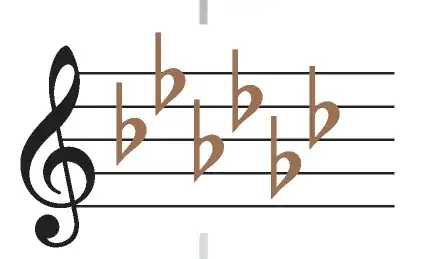
enter image description here

The second to last flat is on G, so Gb Major.

This trick works for all of them except, of course, F Major, which has one flat:

enter image description here

Just remember that one flat is F Major.

For minor key signatures, you can count up six scale degrees on the major key signature, or count down three half steps. I usually count down, because for me that's easier, but it's technically more correct to view the minor key signature as starting on the sixth scale degree.

(Taken from another answer of mine from this question: Finding The Key Of A Song, which I initially misunderstood and this answer isn't relevant to it, but I am glad I left it up!)

General Nuisance
  • 3,787
  • 1
  • 18
  • 44
2

The last flat shown is the fourth note from the scale of the key. Thus just Bb shown, this is the fourth note from F, the key in question.

A key sig.can also mean minor key, so with last (only) flat as Bb, count up two tones to the key note, of D. Thus, Dm.

Doktor Mayhem
  • 36,672
  • 9
  • 65
  • 153
Tim
  • 183,051
  • 16
  • 181
  • 444
0

The fastest way I know is to form a major chord having the key signature's last flat as its root. The third of the chord will be the tonic of the corresponding minor scale; the fifth of the chord will be the tonic of the corresponding major scale.

In the table below, the columns show the last given flat for each key signature and the corresponding relative major and minor keys; the rows show major chords.

# flats Last flat Minor key Major key
1 Bb D F
2 Eb G Bb
3 Ab C Eb
4 Db F Ab
5 Gb Bb Db
6 Cb Eb Gb
7 Fb Ab Cb

With sharp keys, not only does a half-step up from the last sharp give the major scale, but a whole-step down gives the minor scale.

See also this post.

Aaron
  • 70,616
  • 10
  • 97
  • 243