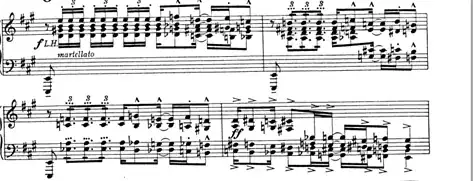
As Laurence Payne's comment says, you've encountered one form of musical shorthand. There are a few layers of shorthand here so I'll break it down for you.
Stripping the first of the first measure of the second line of any shorthand markings, we have just a dotted eighth note.
Now we'll look at that slashy mark across the stem. It just means to subdivide sixteenth notes. A dotted eighth note can contain 3 sixteenth notes. So so far, we have just that: three sixteenth notes, represented by the dotted eighth with the slashed stem.
Secondly, we'll add the little 3 into consideration. Placed above our three sixteenth notes, this creates a sixteenth-note triplet. (Hopefully you are familiar with those.)
Lastly, those three dots above the eighth note indicate that the notes in our sixteenth-note triplet are staccato.
Like Laurence Payne said, it's really the exact same rhythm as the first measure of the first line, but hopefully this more detailed explanation helps you understand the notation a little bit better.