4

I only ever learned the basics of the major scale syllables, mostly from the "Doe, a deer" song.

In C Major,

  • Do - C
  • Re - D
  • Mi - E
  • Fa - F
  • Sol - G
  • La - A
  • Ti (or Si) - B
  • Do - C

So how do you augment this framework with the black keys?

I suppose here, I'm referring to a "Fixed Do" anchored to middle C, but I think (hope) it applies to a "Movable Do" as well, relative to the current tonic.

Bradd Szonye
  • 6,628
  • 9
  • 38
  • 75
luser droog
  • 14,979
  • 7
  • 62
  • 109
  • If this is already covered elsewhere on the site, I couldn't find it by searching for "accidental solfage", so I felt a canonical question was in order. – luser droog Jan 08 '15 at 19:19
  • There are a few different traditions here. While there are accidental systems for fixed-do solfege, my impression is that they are not actually used much for singing. Moveable-do is different. Do you want answers to focus on all the permutations in use, or do you want to focus on a specific method and application, like sung fixed-do? – Bradd Szonye Jan 08 '15 at 19:38
  • Well, hmmm. Specifically, I want enough background to understand the distinction between Ti Ta and Te mentioned in [this answer](http://music.stackexchange.com/a/28518/1344). But more broadly, I'd want something actually currently used rather than more academic/historical (although that's welcome, too. I loves me some history). – luser droog Jan 08 '15 at 19:46
  • That answer is a bit confusing if you don’t have solfège background. Essentially it’s trying to tell you that B, B♭, and B♯ all refer to the same scale degree, differing only in color. In fixed-do, you’d call it *si,* and in moveable-do, you’d call it *ti* or *te* depending on whether it’s flat. (Solfège mostly ignores B♯ and C♭.) – Bradd Szonye Jan 08 '15 at 22:51

1 Answers1

5

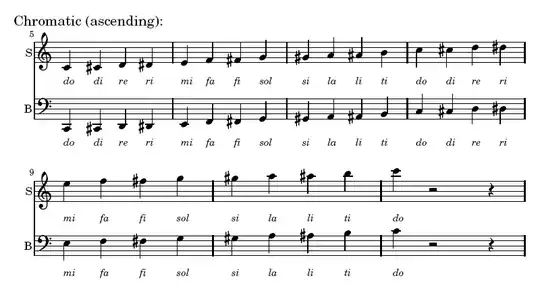
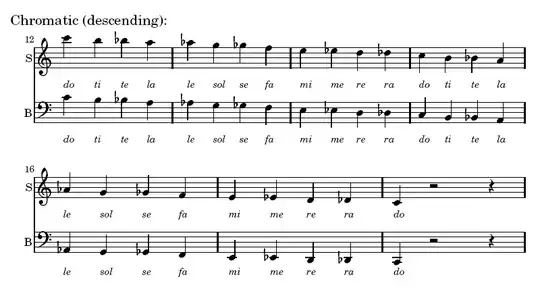
The most standard convention I know of is to change the vowel to "i" for sharping and "e" for flatting. The exception is when flatting "re", in which case you go to "ra".

enter image description here

enter image description here

Casey Rule
  • 2,285
  • 16
  • 34
  • This looks right for moveable do, but fixed do has different common practices. – Bradd Szonye Jan 08 '15 at 21:24
  • 1
    I think in fixed do, there are no alterations (i.e., C, Cb, and C# are all do), right? – Mark Jan 08 '15 at 21:38
  • 1
    @Mark Yes, I think that’s the most common way to do it, although there are [chromatic variants](https://en.wikipedia.org/wiki/Solfège#Chromatic_variants) of fixed do that use alternate syllables. – Bradd Szonye Jan 08 '15 at 22:15