Does anyone know what this is? I was reading a book and they mentioned this. It might be something to do with scales but I am completely unsure.
Asked
Active
Viewed 1,463 times

1 Answers
10
Parallel movement in intervals is when two voices (notes) move the same distance( 2nd, 3rd, 4th, ect ) in the same direction. This can be applied to any interval including 7ths. Here is an example of parallel 7ths:
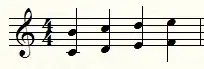
As you can see, C to B is a 7th and then both move up a 2nd to D and C respectively which is another 7th creating parallel 7ths because of how the notes move. This happens again as D and C move to E and D and again once more as E and D move to F and E.
When interval motion is typically discussed it is in reference to voice leading, however typically 7ths and 2nds are left out of this discussion because the are considered to be dissonant and typically not allowed unless used in passing via non harmonic tones.

Dom
- 47,095
- 22
- 150
- 281
-
@Dom- does the kind of seventh matter, whether it's a major, minor, or a diminished? Don't think so. Although often the latter would maybe be written as a 6th, so it wouldn't be part of parallel 7ths... – Tim Nov 02 '14 at 09:31
-
1@Tim The quality should not matter as it does not matter when you reference other major minor intervals like 3rds and 6ths – Dom Nov 02 '14 at 10:26
-
I was thinking of the rule of no parallel 5ths, If the fifth following a p5 is , say, a +5, is that still breaking the rule? Which I don't follow anyway! – Tim Nov 02 '14 at 10:31
-
@Tim According to the "Rules" you don't what to have parallel perfect fifth, but you can have parallel unequal fifths. I don't know any methods that considers a 7th a consonant so I'm not sure if unequal applies here. – Dom Nov 02 '14 at 10:40
-
1@Tim and Dom— although different books use the terms slightly differently, it generally *does* matter what the quality of interval is. Moving from a P5 to a dim5 (where one voice is moving by half step and the other by whole) is more properly called similar motion since the two voices aren't precisely the same. "Parallel unequal 5ths" is technically a contradiction, they are usually just called "unequal 5ths." The "rules" for their usage varied, some texts forbid them completely, some say it's ok from P5 to o5 but not o5 to P5, others don't care at all. – Pat Muchmore Nov 02 '14 at 11:58
-
1It's definitely true however, that similar motion and parallel motion of *imperfect*—at least when they're major or minor, not so much if dim or aug—intervals is often all just conflated and called "parallel" 3rds or sixths. This is because major and minor imperfect consonances generally don't have different functions. Still, M3–m3 is technically only similar, it would have to be M3–M3 to be truly parallel. For dissonances like the seventh, who knows? I can't guess where the OP found a reference to parallel 7ths… – Pat Muchmore Nov 02 '14 at 12:03
-
1@PatMuchmore I would also be interested to find out what book the parallel 7th were mentioned in and in what context. – Dom Nov 02 '14 at 14:35
-
@Dom parallel sevenths are mentioned in one edition of Purcell's "Evening Hymn," though it's just a footnote in the score where the editor says "look at this interesting thing." They arise because the melody has 7-6 suspensions but the stepwise ground bass pattern requires the bass to move to a passing tone as the seventh resolves. – phoog Feb 21 '23 at 07:44
-
@Dom could you explain what do you mean by _unless in passing_? Passing notes? Passing chords? – user1079505 Feb 24 '23 at 17:50