I think you're about right. Homophony is the concept of a single 'line' as such, potentially split across several parts, but all moving at the same time - parts mainly follow the same rhythm. Polyphony is when there is multiple melody lines at the same time, interacting with each other.
What's important to remember is that there should be a degree of flexibility in these definitions, pieces are often 'predominantly homophonic', or have 'polyphonic sections' - a small amount of different movement may mean a piece isn't homophonic in the strictest sense, but would often be referred to as such, if that was the overriding characteristic. As you mention, Alto and Tenor vocal parts often move around to create resolutions within held notes - however if the the parts mainly work with the melody line, this wouldn't be considered polyphonic.
It seems for a piece of music to be considered polyphonic, the lyrics usually need to be independent for each "voice", but this is not a definition I've read anywhere and it wouldn't fit for a piece of music that is without lyrics.
Depends what you mean by 'independent'. A good example of polyphonic songs would be a 'singing in the round' situation, where each voice has it's own line it is following, and not the same melody, simultaneously. With regards to music without lyrics the principles are just the same, polyphonic music would have multiple melody lines; homophonic: multiple parts all moving at the same time.
Some examples:

Homophonic. Note there are some minor, additional decorations on some of the parts, but they mainly follow the same rhythmic pattern.
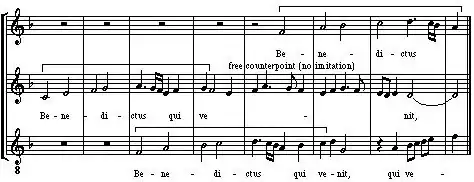
Polyphonic. No relation between the parts at a certain point of the music.


