2

I am having trouble with playing triplets at higher speeds (such as at the end of the Pathetique Sonata, 3rd movement). I find that when I speed things up to tempo that the triplets always turn into 16th notes in sets of 4 rather than remaining as groups of 3. Does anyone have any suggestions?

enter image description here

Richard
  • 82,618
  • 16
  • 186
  • 360
Saemund
  • 61
  • 3
  • Do your 16th notes still start with that really high F and end with the B above Middle C? If yes, are you inserting chromatic notes in between? If you make sure to strictly follow the sheet music, I don't think you'd encounter this 16th-note problem unless you constantly make mistakes (like I do). – Dekkadeci May 30 '21 at 12:18
  • The trouble happens on the second C of the run when the thumb comes down and the cross to the 4 happens. So the beginning of the third set of triplets. The notes are never wrong, only the timing is wrong. – Saemund May 30 '21 at 16:50

3 Answers3

4

If I were having this problem, I would approach it with the following four-step process:

1. Use the beats as anchors

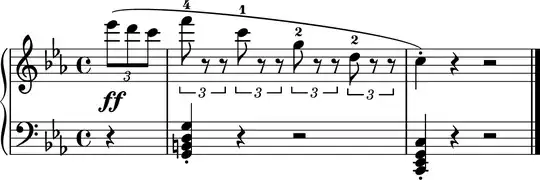
By replacing pitches that aren't on the beat with rests, we can focus to make sure we know where these beats are to be placed. It's also important that you use accurate fingering here, so I've included what my fingerings would be:
enter image description here

(Note that I've kept the entirety of the beat-4 pickup, but you can adjust that as necessary.)

2. Add to that downbeat profile

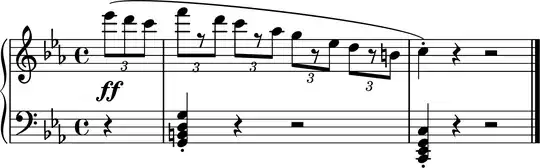
Now that you have the on-the-beat pitches placed correctly, add to it by adding in the third pitch of each triplet:
enter image description here

Again, make sure you're using your eventual fingering when you do this, or else you'll be practicing something different from what you'll perform.

3. Add again to that downbeat profile, but differently

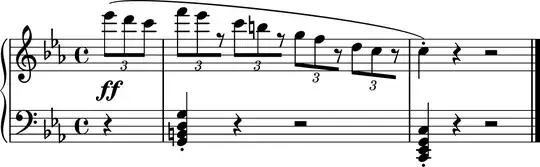
We have the first and third pitch of each triplet grouping, but we haven't yet focused on the second. So now, instead of playing the first and third, we play the first and second:
enter image description here

4. Now put it all together

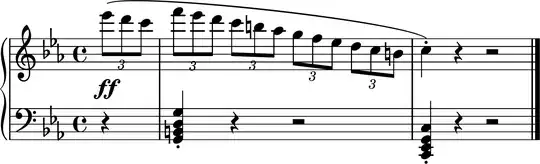
And play it as written!
enter image description here

A Final Thought

This excerpt is really just a C harmonic minor scale in triplets. As such, take some time warming up each day by playing scales in triplets. Most people typically practice scales in sixteenth notes, and this may be the ultimate source of your issue: since you're so used to playing scales in sixteenth notes, that muscle memory is taking over. So incorporate some triplet scales into your routine to make this feel more normative, and this triplet scale in the Beethoven should be no sweat.

Richard
  • 82,618
  • 16
  • 186
  • 360
  • I will try these. The trouble happens on the second C of the run when the thumb comes down and the cross to the 4 happens. So the beginning of the third set of triplets. – Saemund May 30 '21 at 16:53
1

Richard's answer is great. I have no criticisms of it, only another trick to add to your practicing vocabulary: break the motif into groups. I'll share some images to show what I mean more clearly, but before I do I'll explain in words. Beethoven's motif goes Mi Re Do - Fa Mi Re - Do Ti La - So Fa Mi - Re Do Ti - Do; I'm using the hyphens to indicate the triplet phrasing. My practice technique is to change the grouping—play the first two notes quickly together, then the next two notes, and so on; then go in groups of three quickly, and so on; then groups of four, groups of five, and you can go as high as you want. You can also change which note each groups starts on; for example Mi - Re Do Fa - Mi Re Do, etc. You can practice each grouping at slow tempos, medium tempos, and fast tempos, in that order, until you're comfortable.

Duplet and triplet groupings of the Beethoven excerpt

echoes
  • 61
  • 4
0

First, check your fingering. It may be that you are playing the passage so that your strongest fingers are striking each fourth pitch and resulting in an accent.

Then, practice slowly, placing a light pulse on the first note of each triplet. Listen as you go to make sure the accented and unaccented notes (i.e., first note of each triplet versus the other two) sound "in context" (no unwanted accents).

Once you have the feel of that at a slow tempo, gradually speed up. Be very careful to listen along the way, because as we speed up, the tendency is for our muscle memory to kick in, and presumably you're current muscle memory is producing the inappropriate accents.

Aaron
  • 70,616
  • 10
  • 97
  • 243