I am having problems with erosion and can not keep anything on it. I am looking for any ideas to help control this problem. I had a Landscaper come out to look at it and it will cost me up to $50,000 to fix. I just don't have that kind of money.
I am having problems with erosion and can not keep anything on it. I am looking for any ideas to help control this problem. I had a Landscaper come out to look at it and it will cost me up to $50,000 to fix. I just don't have that kind of money.
You need to decide what you want the end result to look like. The choices are:
A quick and dirty solution would be to rake over the area to fill in the gullies. Sow grass seed and top dress. The final part of the solution is to buy a lot of burlap and stake it at the top and bottom. If you can get the grass growing before the summer dry period then you should stop most of the erosion and you still have the option of further stabilization with shrubs.
Let us know what you want out of it and your idea of the effort you want to invest.
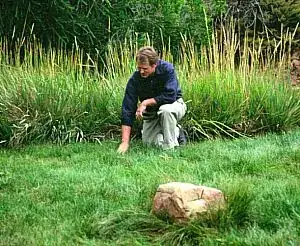
I am working with a similar issue on a pretty tight budget. So far, this has worked quite well for me:
So far I have done two patches. I like the results, and my front yard is no longer brown and washing into the street.
Edit: I looked at your picture again, I think I may have misjudged the size of that slope, the color change in the dirt halfway up confused me. It is probably a lot larger than mine.

I'd call a grass-spraying company. You can get grasses you don't have to mow (pasture grass, tall meadow, short meadow with or without wildflower mix), perhaps weedwack down once a year. The stuff they spray on with the grass will help with erosion, fertilization while the grass is able to establish itself. What is this area used for, how is it related to the rest of your landscape? Where does the water go? Where do you live?
I am imagining this area being a thick meadow of bowing grasses mixed with wildflowers, a few well-placed boulders, a grove of Serviceberry and in the middle of the Serviceberry a small clearing with a gravel floor. A couple of funky and comfy chairs looking back at your home. An old piano chair to sit wine glasses upon. A gravel path takes you back down to the bottom of the ditch which has been filled with a fine, pea-gravel...small drain rock up a little higher from the 'water' of pea gravel, larger drain rock up a little higher than that and then mixed river cobble the highest. The rock dumped, raked and then THROWN into these bands so that each band has larger and larger diameter rock rising from the bottom elevation without any unnatural lines. No 'lines' or placed stones...this makes a beautiful 'dry' riverbed. If this ditch actually carries a lot of water at different times of the year it would be a bit different in design. Under the pea-gravel you would install landscape fabric...if this was a dry ditch. I never use landscape fabric for anything other than over soil and under gravel. (It IS NOT WEED CONTROL...) The fabric stops the gravel from disappearing under the soil.
From the bottom of your 'dry creek' you wind your way back up the bank and sneak into the house by the bedroom patio...
Kids? This is far more exciting than a flat lawn. If the grass gets high enough the kids can crawl through this grass universe feeling like an ant. The well-placed (partially buried) boulders make great spaceships, icebergs, islands...and pea gravel? What fun! Did I mention, no mowing?
Inexpensive, low maintenance and if that IS a road above, some privacy. It is absolutely true that a professional landscape installation will raise the value of your home more than remodeling your kitchen or adding a bathroom. But a professional design should factor affordability. I can't imagine an easier, cheaper way to make that raw dirt become part of your home.


