3

I am looking into installing a sub panel in my basement which will be used to feed electrical circuits to the basement that is currently unfinished. I have an 150 amp main panel and was thinking of installing a 90-100 amp sub panel. I do however have a few questions:

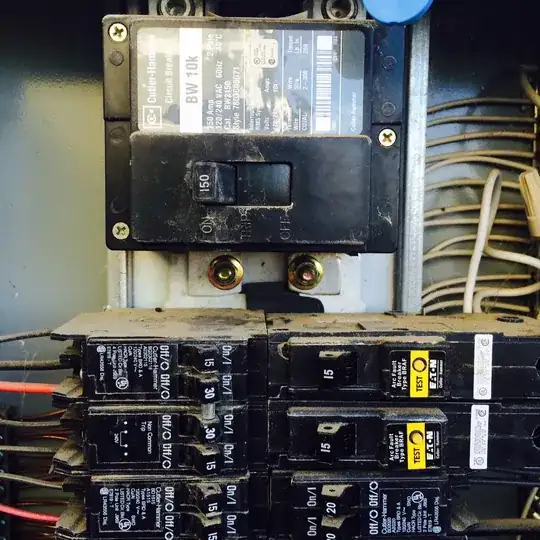
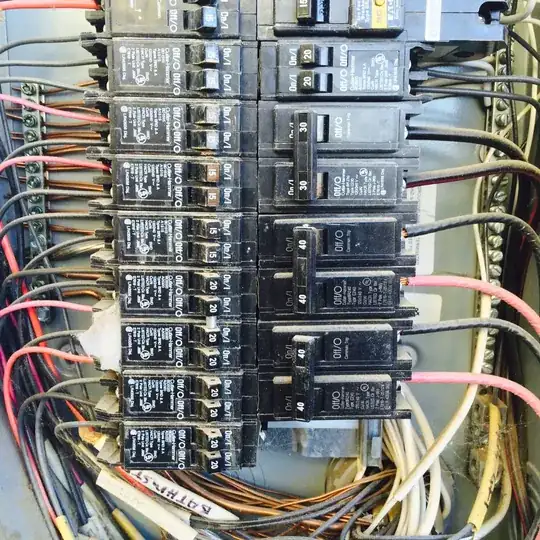
1) Since I do not have any breaker space, I am wondering if there is anyway to replace breakers or shuffle things around to make space? I've included a image below of my panel if it helps anyone make recommendations.

2) Do I need to ensure I use the same brand breakers? I assume yes...

3) Is 100 amp too much for the sub panel in the basement given the main panel is only 150 amps? I plan to have some lighting/receptacle circuits as well as baseboard heaters.

4) What is the proper gauge for the feeder wire? 2-2-2-4 enough for 100 amps? My city uses 2011 national electric code

Any help is appreciated.
enter image description here

enter image description here

enter image description here

Cory
  • 33
  • 1
  • 1
  • 3
  • Can you post a photo of the panel directory? – ThreePhaseEel Feb 12 '15 at 03:41
  • 2
    Holy crow, that's a packed panel! Is this a large home, or is each receptacle on its own breaker? I've seen panels full of regular breakers, but never one full with tandem breakers. Seeing that suggests that maybe you should do a new load calculation (including the new loads in the basement), and see if it's time to upgrade the service. – Tester101 Feb 12 '15 at 13:24
  • It is a larger home with lots of circuits so i'm not too surprised that its full. – Cory Feb 12 '15 at 15:55
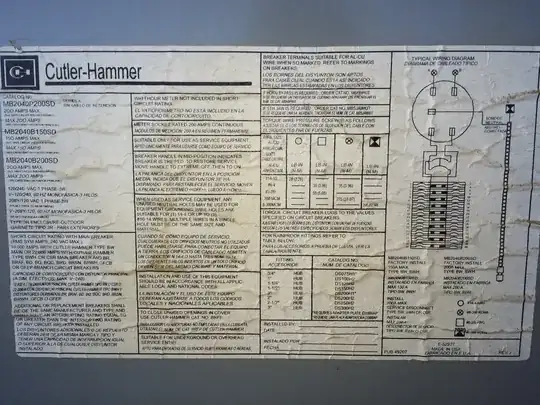
  • Looks to me that there's nothing wrong with it and it was probably done intentionally to avoid a larger panel - maybe. It's really a guess to why but based on the catalog # it looks like not only is it fine, but you could add some more too, which would then give you the space for the other. IIRC, MB2040B... "says" 20 breakers (that's obvious by counting the single spaces) with 40 circuits which means the entire thing is designed to have tandums. – ChiefTwoPencils Feb 12 '15 at 21:03
  • The real question is - why do you need that much power in the unfinished basement. IIWM, I'd do a typical load calculation for the basement add maybe 10% and put a sub-panel for that. 50/60 amps can accomplish a lot. 75 is 1/2 of your main panel and look at all that's in there. You should also check what it's pulling now. Turn everything on, plug additional stuff in, and see where it's at. I doubt you want to limit the main serving the house for an unfinished basement. – ChiefTwoPencils Feb 12 '15 at 21:07
  • Can you provide the square footage of the basement, the number of baseboard heaters you are using, and their specs? – ThreePhaseEel Feb 13 '15 at 01:14
  • 1
    Sure. Sq footage is 1100. There will be 1 bedroom, entertainment center, bathroom and bar. I am planning on 3 baseboard heaters near each window (there are 3 windows) at 1000 watts 240v. I thought 100 amp panel to future proof in case someone ever wants to install a tankless water heater or something with higher amperage requirement especially since once the walls are framed there wont be an easy way to pull a new wire down. – Cory Feb 13 '15 at 15:51
  • You may want to reconsider a tankless water heater. I have written about [my experience in another question](http://diy.stackexchange.com/a/56054/14510). – wallyk Feb 14 '15 at 00:23

2 Answers2

2

I'll address each of your four questions in turn.

  1. You can do this without moving any circuits by replacing the 20A tandem breaker in slots 10/12 and the 30A two-pole breaker occupying slots 14/16 and 18/20 with a 20A/30A quadruplex breaker with a center common trip which will take the circuit from the 30A breaker and independent, non-tied outer trips that take the circuits served by the 20A tandem breaker -- in your case, the Eaton BQC2302120 -- and then shifting the two 40A two-pole breakers (one is in 22/24 and 26/28, the other is in 30/32 and 34/36) on that side up a full width slot (so that you would have a quadruplex in 10/12 and 14/16, the first 40A two-pole in 18/20 and 22/24, and the second 40A two-pole in 26/28 and 30/32). This would then leave you with slots 34/36 and 38/40 open to put your feeder breaker in, which of course must be an Eaton BR two-pole.

  2. Your breakers in the subpanel must match the brand of the subpanel -- there's nothing in the NEC that prohibits a subpanel that's of a different make or breaker type than the main panel. I'd recommend installing another Eaton type BR panel and matching breakers, though, simply for consistency's sake (it makes your electrician's life slightly easier when it comes to sourcing parts, and also makes the subpanel breakers behave the same as the main panel's breakers :).

  3. Since you have 1100 ft^2 of space to cover with this wiring project, you will need to account for a minimum of 3300VA of lighting and general receptacle load; this is based on the 3 VA/ft^2 figure given by Table 220.12 (the 35% demand factor for load over 3000VA given in Table 220.42 is apparently inapplicable in a 220.83(B) calculation). Atop this, you will be putting three 1000VA heaters, giving you another 3000VA of heating load for a total of 6300VA on the feeder, which works out to 26.25A. While it's technically permissible to treat the heating as a continuous load and the general load as noncontinuous load and then use the 215.2(A)(1)(a) method (125% of continuous load + 100% of noncontinuous load) and use a 30A breaker and feeder, I would use a 40A breaker and appropriately oversized feeder (50A ampacity minimum) to be safe and keep voltage drops reasonable. Don't forget to re-run the 220.83 computation for your overall service to make sure you aren't overloading it!

  4. Since you don't need a 100A feeder (the field reports I have read about electric tankless heaters are that they are a real waste of money) and can get away with 40A minimum instead, you can use a smaller cable, all the way to 8/3 NM. If you wish to use the 2-2-2-4 Al SE cable you linked, though (it's cheap!), you will be limited to 75A maximum due to 338.10(4)(a) in conjunction with the 60 deg C column in Table 310.15(B)(16):

Interior Installations. In addition to the provisions of this article, Type SE service-entrance cable used for interior wiring shall comply with the installation requirements of Part II of Article 334, excluding 334.80.

Where installed in thermal insulation the ampacity shall be in accordance with the 60°C (140°F) conductor temperature rating. The maximum conductor temperature rating shall be permitted to be used for ampacity adjustment and correction purposes, if the final derated ampacity does not exceed that for a 60°C (140°F) rated conductor.

Addendum: You are correct in that you can use a heavier-rated loadcenter in this application; however, Eaton does not list a 100A BR main lug loadcenter in their catalog. I'd recommend Eaton part number BR816L125FDP for a flush mount loadcenter or a BR816L125SDP for a surface mount loadcenter -- these are 125A load centers capable of taking up to 8 full-width BR breakers or serving 16 circuits when loaded with tandem breakers and pre-equipped with main lugs to run the feeder into (otherwise, you'd need to burn two slots for a main lug kit). You will also need a GBK10 ground bar here (Eaton makes ...FGDP/SDGP versions with the ground bar preinstalled, but the blue box doesn't carry them).

ThreePhaseEel
  • 79,142
  • 28
  • 127
  • 220
  • Thanks! This is the first truly comprehensive answer i've received.The basement is 1100 sq ft. 1 avg size Bedroom, bathroom, living area/entertainment, small wet bar. I am planning 3 baseboard heaters one for each window at 1000 watts 240v. I thought of using 100 amps just for future proofing unless the consensus is that is overkill. If so, just trying to figure out appropriate amperage and feeder gauge. IF I go 100 amps, was thinking of this http://www.lowes.com/pd_70203-295-13102915_0__?productId=4294349 based on your comment, seems like that works? – Cory Feb 13 '15 at 16:04
  • See my updated answer re: the feeder cable you plan to use. Do you have a local electrical supply house you can order from, by the way, or are you limited to the blue and orange boxes? (The blue box doesn't have the quadruplex breaker I spec'ed...) – ThreePhaseEel Feb 13 '15 at 23:53
  • Does the 3 watts per square foot apply to basements? I thought that was living space. Not to mention the rapidly growing trend of CFLs and LEDs. – wallyk Feb 14 '15 at 00:24
  • @wallyk -- it applies to all finished spaces in a dwelling unit. The reason why it's remained constant is because it covers the general-use *receptacle* load as well, by the way. – ThreePhaseEel Feb 14 '15 at 00:31
  • hmm - admittedly I am a bit lost by the code. Ultimately, it sounds like I should use much lower amperage and appropriately sized feeder. The feeder is where it gets confusing though. Can you clarify the temperature code references? Also, would I just buy a 100 amp panel and use it at the reduced 40 amps? Lastly, I was able to find the breaker you referenced at the blue box for a pretty good price too: http://www.lowes.com/pd_537007-82364-BQ2302120_0__?Ntt=bq2302120&UserSearch=bq2302120&productId=50088172&rpp=32 – Cory Feb 14 '15 at 04:05
  • You can use a 40A feeder breaker for now on the 2/2/2/4 SE cable -- this provides you with a nice, low voltage drop, and the ability to upgrade to up to oh, 60-70A or so simply by swapping the feeder and subpanel breakers. – ThreePhaseEel Feb 14 '15 at 04:09
  • As to the subpanel itself -- there is nothing wrong with using a 100A rated panel at 40A with a suitable subpanel main breaker. However, the breaker you linked is a **BQ2302120** -- this is an *independent trip* breaker, not suitable for mixed 120/240VAC circuits, and requiring handle tying for 120VAC shared neutral or 240VAC-only circuits. The **BQC2302120** I specified has a common trip internal to its 30A sections, which is needed to feed a mixed 120/240VAC load such as a dryer. What load does your existing 30A breaker feed, if I may ask? – ThreePhaseEel Feb 14 '15 at 04:09
  • Lastly, on the Code reference for temperature, the ampacity values are in table 310.15(B)(16) -- use the 60degC column for NM or SE cable. – ThreePhaseEel Feb 14 '15 at 04:11
  • Scratch what I said about putting a main breaker in a subpanel -- you don't need to do that, anyway. – ThreePhaseEel Feb 14 '15 at 04:18
  • According to the panel, that 30 amp breaker feeds our AC. and the 20 amp unit feeds a fridge and bath GFI. As an aside, any recommendations on the specific panel to use? I know if I buy one that is purposed for a main panel I need to make sure to isolate neutral from ground by removing the bonding screw/strap. – Cory Feb 14 '15 at 04:18
  • I updated my answer with a part number recommendation for the subpanel, as well as a ref to 310.15(B)(16) – ThreePhaseEel Feb 14 '15 at 04:51
  • Regarding your comment on independent trip breakers, I just realized the existing one in spaces 1,3,5,7 is indeed an independent trip breaker which feeds a dryer and master bath/study. Does this mean it is in violation of code? Or perhaps the code changed? Home was built in 2006 – Cory Feb 18 '15 at 21:10
  • @Cory -- considering that your dryer is a 120/240V load, it *is* a Code violation! Replace it with a BQC2302115 while you're at all this. By the way, do you have a local electrical supply house you can order parts from, or are you limited to what the blue borg stocks? – ThreePhaseEel Feb 18 '15 at 23:14
  • I do have an electric supply house locally that I should be able to source some of this. – Cory Feb 18 '15 at 23:47
  • @Cory -- Excellent! They should have the ...FDGP/...SDGP versions of the panels I specified, as well as the BQC2302120 and BQC2302115 breakers. Even if they don't have them stocked, they'll certainly be able to custom-order them! – ThreePhaseEel Feb 19 '15 at 01:24
0

You could conceivably move one of the existing 240 breakers to the subpanel so that you would have space to put in the subpanel.

The answer to your other questions depends upon your city inspectors. Give them a call and set up a time when you can go in and talk to an inspector. My city offers an alternative to that; after you get the permit, you can schedule a pre-construction inspection, where the inspector comes out and tells you exactly what you need to do.

Eric Gunnerson
  • 2,844
  • 12
  • 10