We live off the grid and have just installed 26 220V 1.2W LED lights. We are using 220V as the batteries are some way from the house and and thick copper wire is expensive. Everything works on the inverter except the LED lights. We can only use 6 and then the inverter trips out. With everything turned off, adding 1 bulb at at a time and measuring the current, everything is fine until we add the 6th LED light and the current reading starts going crazy, up and down very rapidly until the inverter trips. What is happening here?
Asked
Active
Viewed 1.2k times
5


-
1what happens when you add another appliance on the inverter – ratchet freak Sep 03 '13 at 09:22
-
as long as we use less than 6 1.2w leds everything is fine – Annabel Donald Sep 03 '13 at 09:33
-
1when you plug the 6th one in, have you tried a different LED? or always the same one? – Steven Sep 03 '13 at 11:38
-
we have tried various combinations of bulbs, and even a different brand, as well as 2.3w led bulbs. When we use 2.3w led bulbs we have the same problem but it is the 4th which trips the inverter. – Annabel Donald Sep 03 '13 at 11:56
-
2Some kind of transient is tripping the 'crowbar' circuit that protects the inverter from overload. Talk to the inverter company, they may have a solution, such as using ferrite core chokes (a type of inductor). – HerrBag Sep 03 '13 at 12:24
-
1Are you sure your LEDs are designed for AC? Some are, some are designed for DC. If AC, you may need a harmonic damper circuit (referred to in previous comment). You may need to use a sine wave inverter. See inverter types here: http://en.wikipedia.org/wiki/Power_inverter – HerrBag Sep 03 '13 at 12:33
-
I don't know anything about crowbar circuits, so will investigate that nor do I really understand transient but will look into that too. But yes the bulbs are for AC , 220v they are the standard 50hz so ac. – Annabel Donald Sep 03 '13 at 12:36
-
The inverter produces a modified sine wave – Annabel Donald Sep 03 '13 at 12:40
-
1Can you provide a link to the inverter you are using? Also please describe the power source that supplies the input to the inverter. This information may be helpful in trying to suggest what may be going on with your system. – Michael Karas Sep 03 '13 at 12:57
-
Can't find a link for the inverter, must confess it was cheap and is a stop gap until we can afford the 3.5kw pure sine wave inverter. Power source is 2 12v 100 amp hour batteries, fully charged. – Annabel Donald Sep 03 '13 at 13:01
-
1So if you plug those 26 into a normal 220volt outlet they work? – Piotr Kula Sep 03 '13 at 14:02
-
Can you provide a make/model or link to the LED specifications? – wallyk Sep 03 '13 at 14:54
-
In answer to ppumkin, yes they do. I should have said before if run on the generator there are no problems. – Annabel Donald Sep 03 '13 at 16:31
-
ledbulbs are a standard GU10 connection 220v 1.2w 50 hz warm light – Annabel Donald Sep 03 '13 at 17:32
-
Is your inverter 800W continuous or 800W peak? The peak ratings could easily be a bit lower than advertised. – Jason Sep 03 '13 at 21:40
-
1The best, most diagnostic question you have not answered: what happens if, besides the LEDs, you first plug in a standard 50 watt load, like an incandescent light bulb? Do the LEDs light okay? Does the inverter still trip? – wallyk Nov 04 '13 at 07:07
7 Answers
5
This is almost certainly from using a "modified square wave" - MSW - inverter rather than a "true sine wave inverter" - the power conversion circuits in AC LED fixtures expect a sine wave input, and the way they behave when fed MSW input is upsetting your inverter.
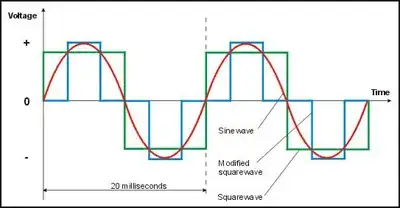
One possible solution, short of "buy a new inverter" (a rather expensive proposition, especially for true sine) would be to feed the light circuits (only) though a small isolation transformer. The inverter power would feed into one side, and you'd feed the lights a much better approximation of a "true sine wave" from the other side. It should be a bit oversized for the load, since the MSW input will cause some heating of the transformer that a normal sine wave would not. However, the load is so small that almost any isolation transformer will be a bit oversized for it. Find the minimum size by looking at the VA (not W - power factor matters, a lot, here) rating of your lamps, and then run a fudge factor for MSW input of about twice that rating.
Unless the VA is absurdly bad for a 1.2W device, something like this for roughly $50 ($40.76 plus shipping) will probably work. You'd also need to mount it in a safe enclosure, provide circuit breakers or fuses, etc...

Ecnerwal
- 174,759
- 9
- 212
- 440
3
It is most likely related to the inverter that you are using. Some inverters are sensitive to the kind of load that you put on them, and LED bulbs could easily present that kind of load. The inverter might be better behaved if you give it a better load - like a nice 50 watt incandescent light - along with the LEDs, though that obviously runs your batteries down much more quickly.
A UPS would work if it were always on, but there aren't that many that work like that, and they tend to be expensive.
Another approach is to take the 220VAC and use it to charge a 12V battery in the house, and use that to run 12V lighting. Obviously more of a hassle because you'd need separate lighting circuits, and you'd need to find a 12V battery charger that your inverter would be happy with.

Eric Gunnerson
- 2,844
- 12
- 10
-
2Maybe the inverter is doing square-wave output and the LED units are reacting to it with current peaks at the voltage rise. Then 6 times that current peak is too much for the inverter to handle well at that one point in time. – Skaperen Oct 06 '13 at 18:31
-
Certain UPS designs are "always converting" from AC to DC and back to AC. See "dual conversion". – Skaperen Oct 06 '13 at 18:31
1
As a temporary fix, I would use an appropriately rated UPS (sized for future computer needs, not just for this LED situation (which is nominally only 31.2 W))
The UPS will cleanup any transients, and depending on "mains failure time", can supply backup power to facilitate an orderly shutdown or bridge switch-overs between mains and batteries
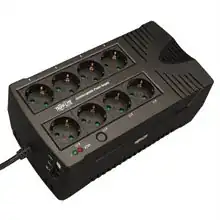
One company that has European UPS products is Tripp

HerrBag
- 12,066
- 1
- 19
- 37
0
Sounds like you're running into trouble with the light's forward voltage drop At 220v and 26 lights, you've got 8.5 volts per light. How many actual LEDs are hooked in series inside each light, what's the drop of each, and what other weird circuitry is hidden within the base?
Ignoring those questions, the fix for voltage drop problems is to wire sets of the lights in parallel. Try two lines of 5, and see if that works.

Wayfaring Stranger
- 3,355
- 1
- 16
- 17
-
4I do not believe that the OP is using LEDs that would be wired up in series. They have stated that they are using 1.2W LED lighting fixtures that are designed to run on 220VAC. Such lighting fixtures would be all run in parallel off the output of an inverter designed to output 220VAC. – Michael Karas Sep 03 '13 at 13:01
-
The 26 bulbs are wired in 3 banks of 6 and 2 banks of 4, obviously in parallel. If we turn on one bank of 4 no problems. If we turn on 2 banks of 4, or a bank of 6 the inverter trips. I will look into forward voltage drop as I don't really understand that. I'm sorry but I don't understand the 8.5v per light, 8.5 volts in total yes but not per light – Annabel Donald Sep 03 '13 at 13:07
-
@Michael Karas Question doesn't say how the lights were designed, or how they're wired. Thus figured it best to cover this common LED wiring problem. – Wayfaring Stranger Sep 03 '13 at 13:08
-
@AnnabelDonald LED's require a certain voltage to fire. When you put them in series, a string of them will light up, until you reach the point that (total voltage) / (# LEDs) is less than forward voltage drop. With circuit description you gave, it doesn't sound like this is your trouble. – Wayfaring Stranger Sep 03 '13 at 13:42
-
@AnnabelDonald What if you power 4 LED's chained up, then use a separate power cable to power another 4 LED's chained in parallel. Are you sure you can chain 26 LED modules one after the other? So use 2 different cables to power 2 sets of 4 LED (8 in total) See if that trips the inverter. – Piotr Kula Sep 03 '13 at 14:08
-
It would be really helpful to see a picture of the LED. Do you wire then chained up? Or of a a dedicated power cable. Forward voltage might be a problem yes - if the next LED is leaching of the previous. We need more info @AnnabelDonald Some drawing of how its wired and the type of LED. Have you actually got these to run on normal 220v? – Piotr Kula Sep 03 '13 at 14:14
-
The problem is very clearly to do with the inverter, perhaps I should have mentioned it before but when run by the generator, there is absolutely no problem. So having in my mind eliminated – Annabel Donald Sep 03 '13 at 14:17
-
In my opinion the problem is very clearly to do with the inverter, perhaps I should have mentioned it before but when run by the generator, there is absolutely no problem. So having in my mind eliminated problems with the bulbs, problems with the basic wiring, the only option left is the inverter. For some reason as Herrbag said a transient is occurring causing the inverter to trip. Currently looking to see if it might be because of the modified sine wave, but doubtful as the 3KW generator was not expensive and very unlikely to give out a pure sinewave. – Annabel Donald Sep 03 '13 at 14:22
-
2I don't understand this wire then chain up, they are led bulbs designed to go into standard light fittings. So in theory standard house wiring, standard light fittings and hey presto.......or so I thought. – Annabel Donald Sep 03 '13 at 14:25
0
You are using only one cycle (led lamps uses only one direct current (one way conduction) and that's what activates overload protection) you are using a signal integer and your integer thinks that you will consume around the same amount of current on positive and negative cycle, but you admit the power he sent to feed (lets say) the positive cycle and reject the power produced for the negative cycle, so he doesn't understand what do you want, try to state which polarization they use connecting a diode in series, then connect one half of lamps in +- direction and the other half -+ direction
You could also connect a rectifier bridge on the overall led´s line


0
Led lamps don't use squrewave power source which your inverter gives you. Change you bulbs to cfl or get a pure sine wave inverter.

Martin
- 1
-
Hello, and welcome to Stack Exchange. Why do you think that's true for LEDs but not for CFLs? – Daniel Griscom Mar 26 '16 at 12:06