2

I have water issues in my basement - as you can see, it comes in via some cracks between my basement floor and the concrete pads that the washer/dryer sit on.

Water coming in

I am working on fixing the problem from the outside, planning to re-grade the land around my house and fix some gutter issues to keep more water away from my foundation. Is there anything I can use on the inside here, to help keep any water that gets to this area from coming in?

Chris Marasti-Georg
  • 229
  • 1
  • 3
  • 11
  • The water is coming from under the concrete pad? Are you sure it's not coming from the washer somewhere? A leak underneath? Drain overflowing? Broken drain underneath? – DA01 Jul 22 '13 at 23:58
  • @DA01 Yes it's definitely coming in under the pad, from the outside. That's actually the dryer in the picture - the washer is on the other side. – Chris Marasti-Georg Jul 23 '13 at 00:27
  • Is the pad near the wall? Is that on the wet side of the house? – DA01 Jul 23 '13 at 00:29
  • @DA01 The pad touches the wall (no visible seam), and the water isn't visible where the pad and wall meet. That is the wet side of the house. – Chris Marasti-Georg Jul 23 '13 at 00:46
  • Well, see how the gutters and regrading do. That might be enough to fix the issue. If it's not, then you might need to look at some perimeter french drains and a sump pump. – DA01 Jul 23 '13 at 00:49
  • As DA01 said. Because any kind of sealant applied to the inside like I believe you are thinking will be ineffective. Ideally, stop the water from entering. If you can't, you have to collect it and remove it. Basically restating DA01 in generic terms because there may be more than one approach to meet a need. – bcworkz Jul 23 '13 at 01:29
  • Just to rule out a drain issue, does it only occur when its wet outside, or does it occur when the washing machine is on? – Steven Jul 23 '13 at 11:59
  • @Steven yes it's only after hard rainfall (which has become the norm lately). Thanks everyone else – Chris Marasti-Georg Jul 23 '13 at 12:15
  • Gutter and downspout repairs can do wonders. I had to reattach the downspouts to the ground drains at my house. It solved a ton. I had water spray from crack 5 feet into the basement. Now, not a single drop. – Evil Elf Jul 23 '13 at 12:24
  • @ChrisMarasti-Georg - Did you send up solving your issues? If so, how did you go about it and how well did it work? – bubbleking Apr 24 '16 at 16:58
  • 2
    @bubbleking I ensured that water from the gutters was released about 8 feet away from the house. Haven't had the problem since. – Chris Marasti-Georg Apr 28 '16 at 14:19

1 Answers1

4

For a complete repair there are 2 obvious directions to cover which you mentioned. I'll go over what I would do in your situation.

Fix from inside

One product I would use is a hydraulic cement which can be found easily at your local home improvement store. This stuff is great for fixing large leaks in the basement.... if you can find the source. Hydraulic cement would be more permanent than a concrete filler or sealant and is commonly rated to 2000lb to 3500lb of hydrostatic pressure. Stay away from your cheap concrete sealant you would find somewhere like Home Depot. Most of these are water resistant, but not at all made for stopping leaks. Assuming you do find your leak source and fill every hole, the main cause is still unaddressed. For that we go outside.

Fix from outside

Fixing grading and downspouts will help a lot, however, in torrential downpour you may still get heavily saturated earth around your foundation, which is a bad thing. Even worse, (depending on where you live) is water expansion as it freezes in the cracks. This could seriously worsen the issue.

Probably one of the best (and probably the hardest solutions) is to use a polyethylene foundation wrap, something like this, in conjunction with a proper drain system at the bottom of the footing. Below is an example installation from the DMX installation guide found here.
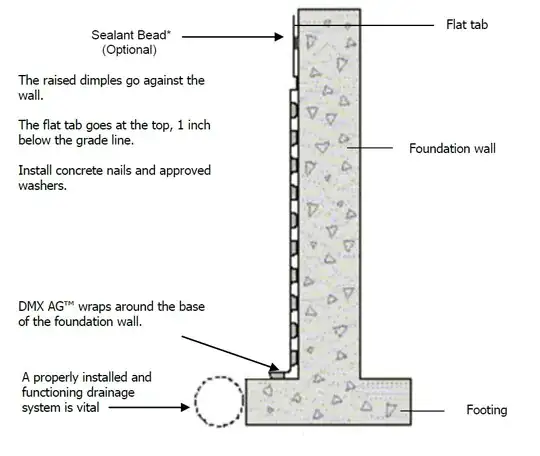
Foundation Wrap Example via DMX installation guide

A perforated drain pipe, crush rock, and proper drain or drainage field is necessary to keep the water moving. Below is an example of a proper drainage system as provided by the EPA
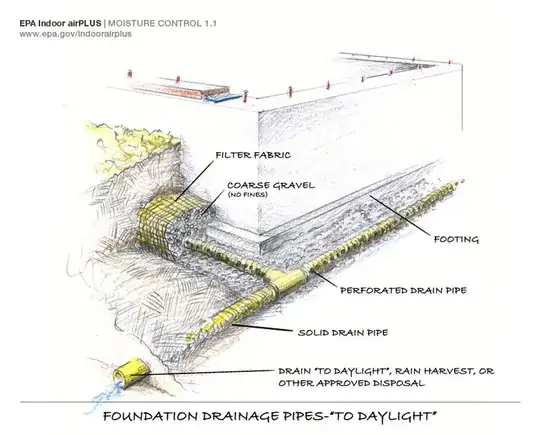
enter image description here

Hope this helps, and best of luck!

John Smith
  • 806
  • 3
  • 8
  • 15