9

What I'm looking at here?

This is a picture of my guest bathroom sink, and the hot and cold inlets are each connected to two or three seemingly redundant lengths of copper tubing:
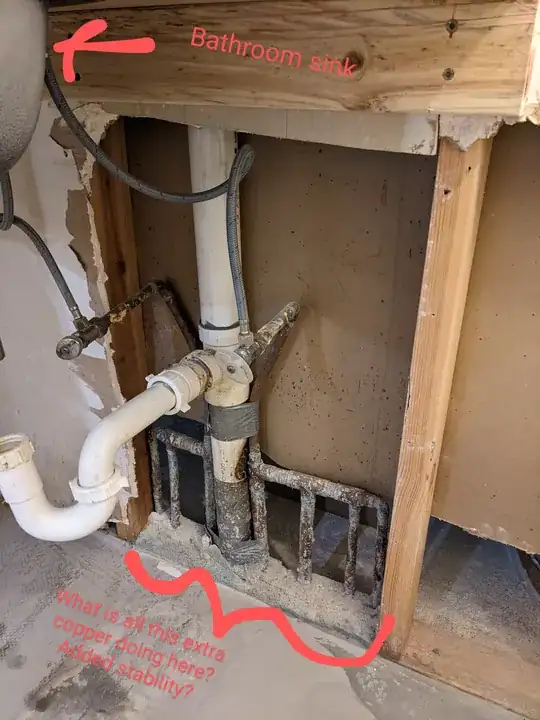
Extra copper tubing

My first guess is, the plumber who built this in 1978 needed to add stability and, being a plumber, used what was handy. But that can't be right, can it? That's a lot of wasted solder, considering a 2x4 and a couple of nails would have probably accomplished the same job.

The kitchen sink plumbing has the same feature.

mattalxndr
  • 223
  • 1
  • 5
  • 2
    I imagine those extra pipes go to other fixtures. It does seem odd since most would just tee off the main line to go to a sink/tub/whatever and continue the main line to the next fixture. – crip659 Mar 15 '23 at 16:09
  • 1
    Aside, is it normal for the plumber to burn the PVC drain pipe when soldering the adjacent water pipe? – user253751 Mar 16 '23 at 22:57

2 Answers2

25

That's a manifold and those other pipes go on to feed other devices.

Very likely that the plumbers ran one 3/4" copper tube to the room, then branched off there and ran the other 3/4" and 1/2" pairs to feed other things in the room or in adjacent rooms.

You even have one more cold than hot, which suggests that it feeds a toilet.

Update to add context: In slab-on-grade construction where the piping is under the slab, this is common and it is much cheaper and easier to run one or two long runs back to the place where the water enters the house than running homeruns to every water-using device.

The decision to run the pipes in-slab rather than in the walls? I don't know the reasoning behind it. I just know that I've had homes where the piping is underslab, and homes where the piping is in the walls, but I couldn't tell you why.

Chris O
  • 6,084
  • 1
  • 6
  • 42
  • 6
    Those other devices don't necessarily still exist (meaning that the pipes are capped off further downstream), which could explain mattalxndr's confusion. – Toby Speight Mar 16 '23 at 07:19
  • Ran pipes *back into* the concrete slab? – RonJohn Mar 16 '23 at 20:41
  • @RonJohn Exactly. Loops of flexible tubing (sometimes copper, although in the last couple of decades PEX has taken over) laid before the slab was poured, then the in-wall pipes were added after framing. – Chris O Mar 16 '23 at 20:48
  • Why not run the pipes directly to the various destination (or have the splits be under/in the slab)? – RonJohn Mar 16 '23 at 20:53
  • 1
    @RonJohn You'd have to ask whoever designed the building. I've lived in places with both schemes, but the reason behind it is out of my scope. – Chris O Mar 16 '23 at 20:55
  • Could just be a sequencing issue. If the plumber comes in before the framers, you'd want to run through the slab. – fectin Mar 16 '23 at 21:44
  • To answer "why": Today it is more common in the US to install one or two big PEX manifolds from which all fixtures are individually fed. In 1978 it was not. Typically a house, or parts of it, were fed serially from fixture to fixture. To the mind of a 1978 plumber, if you can't go serial because you can't make in-slab joints, you just bring those joints above ground *locally*, with a manifold for the room and maybe adjacent rooms. I'm curious whether a 2023 slab home would have a big central manifold with loads of single-fixture pipes underground. I haven't seen how that's done today. – jay613 Mar 16 '23 at 21:44
  • One guess why pipes might be under a slab in certain climates is to prevent them from freezing – user253751 Mar 16 '23 at 22:59
  • 2
    @RonJohn there are not supposed to be sweated connections in soil contact. The runs of copper tubing under the slab are unjointed soft copper bent in a sweeping curve to come out of the slab. – Jim Stewart Mar 17 '23 at 21:26
  • @JimStewart perfect!! – RonJohn Mar 17 '23 at 22:42
  • "suggests that it feeds a toilet" The toilet supply emerges from the slab a couple of feet away. Why do you suspect they didn't just run a line through the wall? – mattalxndr Mar 18 '23 at 09:01
  • @user253751 These are in Texas, US. We have freezing weather only a few days a year. – mattalxndr Mar 18 '23 at 09:03
15

I don't have code requirements handy, but there was another question here recently that was similar, and the answer there was that plumbing code did not allow copper pipe joints to be embedded in concrete, so all soldered joints needed to be above the concrete. It looks like you're in a similar situation on a concrete slab, so likely this is the same rationale.

Milwrdfan
  • 2,519
  • 9
  • 14
  • So... on a related note. If I uncovered the base of, cut, then soldered a cap onto a fridge ice maker supply pipe, then covered the whole mess in an inch or two of spray foam, then poured sand mix around that to fill the hole in the slab, would you guess that is against code in the US? Signed, Crossing My Fingers – mattalxndr Mar 15 '23 at 21:33
  • 3
    @mattalxndr Probably best to ask that as a separate question to keep things organized. More details and a photo would help. – Armand Mar 15 '23 at 21:53
  • 4
    If no joints are allowed to be embedded, how do the portions of the pipes below the top of slab go other directions? Are they just bent with a pipe bender? – Huesmann Mar 16 '23 at 13:28
  • @Huesmann In my experience (only had 2 homes that were slab-on-grade with underslab pipe), the underslab pipe was flexible tubing, all laid before concrete was poured. Once framing was complete, rigid pipe was soldered to the ends. – Chris O Mar 16 '23 at 20:45