11

I'm trying to prepare for EV charging and have been researching on different EV user chat rooms.

I have the option to install a manufacture charger or something like a NEMA 14-50 receptacle for charging and I'm opting for the latter. Users have suggested buying an industrial grade 14-50 receptacle because they deal better with heat, have better mechanical connection mechanisms for the feeder wires, etc.

An electrician told me that all 14-50's are the same b/c they have to pass the NEMA standards.

The cost difference is ~$80 USD for an industrial strength one vs. ~$10 for one from a big box hardware store.

Do I need an industrial strength one for EV charging?

I'm considering just plugging the mobile charging cable to the 14-50 outlet...instead of installing a special charger.

Update I actually installed a 14-30 receptacle b/c I'm only able to have 30 amps on this particular circuit. (The mobile 14-30 dongle tells the mobile charger to limit the max current to 24A)

milesmeow
  • 4,890
  • 24
  • 96
  • 131
  • 5
    Depending on your location, the recommendation is to hardwired the charger to the panel. New code requires GFCI protection for receptacles in garages/outdoors. EV chargers have built in GFCI that is usually better. So no plug/receptacle. – crip659 Oct 31 '22 at 17:49
  • Yes, for this question to make sense you'd need to explain what that means. – isherwood Oct 31 '22 at 18:19
  • @crip659, you've misunderstood the question. It's not a matter of hardwiring or plugging in a _charger_. It's a matter of hardwiring a charger or plugging in a _cord_. Your suggestion doesn't apply. – isherwood Oct 31 '22 at 18:20
  • They're all the same until the springiness of the terminals goes away and the high currents start arcing with the bad connection. That being said, I have a $10 outlet for my EVSE. The one I bought happened to be a plug-in so I did it that way rather than putting much thought in plug-in vs hardwire so I definitely didn't think much about $10 plug vs $80 plug. – Dean MacGregor Nov 01 '22 at 15:23
  • NEMA doesn't specify lifetime, to my knowledge – crasic Nov 01 '22 at 22:33
  • I don't think you make clear in your question: are you just plugging in direct car->outlet? Is the intent here not to buy anything to manage the charging, and just have a cord from car to a 14-50 wall outlet? – Joe Nov 01 '22 at 22:48
  • @isherwood What's your point? So what if it's not exclusive to EVSEs? The OPS should still seriously consider hardwiring and avoiding the expense of a redundant GFCI. – nobody Nov 02 '22 at 02:02
  • My _point_ is that there's nothing to hardwire in the second option (which happens to be my preference for EV charging), so much of the pontification and some of the answers hare are irrelevant. I made no mention of EVs, nor are GFCI's relevant. – isherwood Nov 02 '22 at 14:31

6 Answers6

29

TLDR: the cheapie 14-50s are made for unplugging once every 20 years when you buy a new range. The quality 14-50s are made for daily use at RV parks. But consider alternatives for many reasons.

The common beliefs in the EV community are wrong

Because they are EV owners, not electricians.

However you've been swept along in this "stock advice that is wrong", and I implore you to turn away from that path before you sink any money into hardware.

Otherwise you will end up in a dumb situation where you are overloading your house for a charger you use once a week LOL.

You don't need a huge charger. I know the subject better than Alec from Technology Connections, and Alec is correct unlike almost every other Youtuber* out there. Here - on sizing your charge speed. I cued you up to 32:55, the meat is just a couple of minutes long.

That travel charger is really meant to live in your trunk and be used, you know, for travel. The two sockets are the normal socket + a NEMA 14-50 RV socket because those are found at RV sites. EVs don't even use the neutral. (yes I know your tossed-in "travel EVSE" only has 2 speeds; we'll come back to that.)

First fatal error: The house probably can't power this

Builders are cheap, and they're not in the habit of building houses with 50A of reserve capacity. Services are 100A, 125A or 200A mostly, so this is a huge fraction of total capacity.

Panel loading computed via NEC Article 220's Load Calculation. It's strange, but it's data-driven science and it's proven valid. When a major load is added, the Load Calculation must be re-done. Adding an EV is definitely one of those times.

It's very common to find 50A is "a bridge too far", but 20-30A is viable... and if you made it in that video to where Alec is waving around yellow Romex, you're not worried.

Also, there are ways to share the slot in the Load Calculation with other appliances, particularly dryers if they have 4-prong sockets.

How do we get other 'speeds' on a travel EVSE?

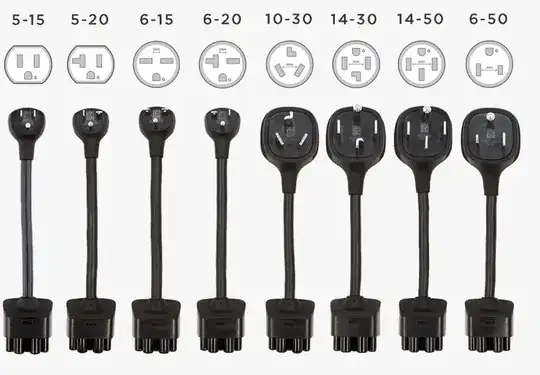
Like this if your travel EVSE sells other dongles.
enter image description here

See, each dongle plug has a microchip inside. The microchip says "Hey, I'm a 30A plug!" and the EV says "OK, I'll draw the right amount of current for that". EV charging is slick. So if you install a 20A circuit just install a 20A socket and order that dongle plug. Easy peasy.

(note that using "cheater cords" with travel EVSEs is a recipe for disaster.)

Another way is to go with a wall EVSE, which is either set to the appropriate amperage at install time, or is hardwired that way from the factory coughCrippleCreekcough. It automatically tells the car "Hey, you're on a 20A circuit".

Oh, snap. GFCI requirements.

First, let's be clear: EVSE's already contain a smart GFCI that knows how to self-reset. So adding a dumb GFCI means waking up to a tripped GFCI breaker, totally unnecessary.

And what's more, the only way to protect a 240V socket is a costly 2-pole GFCI breaker, which must be right for your panel (procurement headaches) and isn't even available for older panels like Pushmatic or early GE.

Fortunately, you only need GFCI protection if 3 things are true.

  • your state has adopted NEC 2020
  • your state did not delete the requirement (many did)
  • you use an EVSE that connects "cord-and-plug" (not hard-wired).

This is a good case for a hardwired EVSE, which must necessarily be a wall unit.

So if your state requires GFCI, that's a case for stepping away from the "travel EVSE" as your primary unit and using a hardwired wall unit.

A lot of people are in a hurry to "save money" by using the provided travel EVSE as their daily charger. But then they have to buy a $150 GFCI breaker, a $60 quality socket and weird box lid (people have a lot of trouble finding the right lids), very costly 6/3 w/ground cable -- and they wind up flying right past the cost of a $400 Tesla Wall Connector, $12 breaker and some 12/2 Romex.

To answer your question, though.

What people say on the internet about cheapie NEMA 14-50 sockets is entirely valid. Prior to 1996, dryers and ranges weren't required to be grounded, and the following logic was used: "Dryers and ranges are rarely unplugged, so the plug and socket are unlikely to have a problem. As such, the neutral is probably reliable enough to serve as ground". The body count ultimately said otherwise. And what emerged was that large 30 and 50 amp sockets are not designed to survive daily plug/unplug. That is, you buy a range every 20 years and they're designed for that.

Of course that isn't good enough for an RV park, so the industry responded with industrial-grade 14-50s which are made for daily plug/unplug.

Wait. Dryer cheat?

Yes. In the Load Calculation, a dryer is allocated 5500 watts. A "30 amp" EVSE (actually providing 24A continuous to the EVSE) is allocated 5760W. Close enough.

Now here's the cool part. Code allows any number of 30A general-purpose receptacles on a 30A circuit. (NEC 210.21 and 210.23). So you can have 1 general purpose circuit feeding a dryer and a general purpose 30A receptacle in the garage. If you plug an EV into it from time to time, good on you.

The gotcha here is that thing about dryer circuits not being grounded prior to 1996. The good news is, ungrounded cables quickly went obsolete by 1970, so they were supposed to have run 10/3 w/ground cable to even a 3-prong (hot-hot-neutral) dryer circuit. If both neutral and ground are present in the box, the circuit can be extended to a NEMA 6-30 or 14-30 socket (whichever your EVSE has a plug for).

Just don't use the dryer and EVSE at the same time, but, that's true of anything (e.g. in the kitchen don't use two 1500W heat appliances on the same circuit at the same time). No interlock is needed (though they sell some fancy ones).

This does not work with water heaters (which are only 4500W anyway) without some sort of interlock. Doesn't work with ranges (can't have 2 sockets on a 40-50A circuit). It might work with A/C units with a certain trick.


* Youtube is a racket. It exposes people "good at the Youtube ranking game" and NOT experts. The only Youtubers I've found who get their facts straight are Blancolirio, Benjamin Sahlstrom, John Ward, Technology Connections and maybe Perun (whose methods seem sound, but I don't know The Dismal Science enough to fact-check).

Harper - Reinstate Monica
  • 276,940
  • 24
  • 257
  • 671
  • 1
    Do *all* EVSEs reliably have smart GFCI or is that something that people should check for in the specs before buying? Is it just the hardwired kinds and the plug-ins don't? – Dean MacGregor Nov 01 '22 at 15:18
  • 2
    @DeanMacGregor All legitimate and legal EVSEs have to, since the "car" end of an EVSE is something that supplies a whole lot of power, at a high voltage, it is routinely used outside in rain and all sorts of other nastiness, and runs the risk of electrifying the metal chassis of a car which is not directly grounded and tends to be touched by unsuspecting people all the time. News reports of your EVSE product electrocuting people are bad for sales. Plus there's tons of things that can go wrong in the car and the EVSE needs to stop feeding power in if something is amiss. – TooTea Nov 01 '22 at 15:56
  • @DeanMacGregor Yes, to meet UL and EU standards it must have GFCI protection. Big Clive has tested two cheap Cheese units and found *both* had the required AC GFCI protection that worked. My understanding is the OpenEVSE has it too. – Harper - Reinstate Monica Nov 01 '22 at 21:05
  • If the amperage is the same, how can we move from "6/3 w/ground cable" to "12/2 Romex"? – Alexander Nov 02 '22 at 19:06
  • 1
    @Alexander because the amperage *isn't* the same. This is not your father's battery charger. They are MAGIC, if you count 1980s-era microcontroller tech as "magic" lol. EV charging *dynamically adjusts to circuit capacity* see 12:51 here. https://youtu.be/RMxB7zA-e4Y?t=555. – Harper - Reinstate Monica Nov 02 '22 at 19:20
  • I am still doubtful there is enough magic in them to pull more than 20 amp over 12/2 Romex. – Alexander Nov 02 '22 at 20:19
  • 1
    @Alexander "Doubt" is real common with EV charging technology, because the technology is moving a lot faster than peoples' willingness to embrace change. It's weird because the technology is actually 1980s tier -- there was just never a *necessity* to use it in these ways. Now there is. Any EV needs to be able to plug into any EVSE and charge at a rate correct for that EVSE's wiring. – Harper - Reinstate Monica Nov 02 '22 at 22:52
  • Ok, so this about wiring, and 6/3 w/ground cable can bring in much more current than 12/2 Romex. My point is whatever setup we choose, wires will be a limiting factor. – Alexander Nov 02 '22 at 23:47
  • 1
    @Alexander confused because that doesn't correlate with your earlier comments. There are many limiting factors other than wires, like safe load on panel. Being able to restore 400 miles into your EV overnight is fairly pointless if it has a 250 mile battery and your commute is 40 miles. That is Alec's point https://www.youtube.com/watch?v=Iyp_X3mwE1w&t=1975s. – Harper - Reinstate Monica Nov 03 '22 at 00:07
  • I think you meant Clipper Creek instead of CrippleCreek. (At the end of the "How do we get other 'speeds' on a travel EVSE?" section.) – procrastinate_later Jan 25 '23 at 15:24
9

The big difference in any receptacle is going to be the components used inside. Compare the cheaper $1 NEMA 5-15 outlet with its more sturdy $3 counterpart sometime. There's a large difference in quality.

What you're talking about would be like a Hubbell receptacle vs the $10 14-50 you can buy at your local big box. When they say "commercial grade" they generally mean it's designed to take a lot of punishment. I mean, Grainger sells a single Hubbell NEMA 5-15 for around $25, with this note

Superior impact resistance Circuit identification Reduced heat buildup Low resistance to ground path

You're not going to find Hubbell at your local big box because why would I pay $25 when there's this $1 model right next to it?

So what are you paying for?

A NEMA 14-50R isn't used for a lot around your house, but it's used for a lot in industrial applications. If you're running an ARC welder off one, you're probably in a situation where it's going to get beat up some (either by folks plugging and unplugging, or just by hitting it in general). You don't want run-of-the-mill there because it's likely to break under that level of stress.

It's unlikely you're going to be anywhere near that hard using your EV plug. You might be plugging and unplugging it, but odds are it's the end you put on your EV that will see the most action there. You'll probably plug the 14-50 end up and leave it be.

In other words, your garage is not as harsh an environment as a welding shop or other commercial environment. You will probably be just fine with the $10 one. Put your money into a good EV charger that has a long cord and takes a 14-50 plug.

Machavity
  • 23,184
  • 6
  • 41
  • 90
5

TL;DR Hardwire

In general, a hardwired connection is going to be more reliable than a plug-in connection. There is one less point of failure. This applies to dishwashers, garbage disposals, ovens, EV chargers (not technically chargers - Harper can explain - but we'll go with the common terminology), hot water heaters, wall and ceiling lights, etc. Basically any device that is permanently attached to your walls/floor should ideally be hardwired.

There are exceptions. In some cases local rules may require plug-in for a dishwasher, disposal, etc. In some cases GFCI protection is required and adding that using a GFCI/receptacle may be easier and/or less expensive than a GFCI/breaker, at least for 120V 15A/20A circuits. And there are other exceptions (I had a hardwired light, replaced it with a plug-in out of convenience, then eventually added a receptacle to the switched circuit so that I could plug in the same light fixture rather than buying another one. But I have others that were plug-in which I replaced with hardwired when I replaced the fixture.)

EV charging is new, and if you already have an existing suitable receptacle (e.g., a 14-30 for a clothes dryer) then the natural thing to do is save money by reusing the receptacle. That makes some sense, but if the receptacle is going to be switched back and forth (e.g., between clothes dryer and EV charger) then it actually can lead to problems. Receptacles larger than 20A are generally not designed for frequent swaps - they use heavier wire/plugs/cords and are designed to fit very tightly to avoid arcing and other problems. Occasionally someone will have a large receptacle which is totally unused (e.g., they replaced an electric dryer with a gas dryer so the 14-30 is 100% available) but that is relatively uncommon. Which all means that in most cases you need to add a new circuit, whether you use a receptacle or a hardwired connection - i.e., no savings from reusing an existing receptacle.

In addition, there is a big problem with GFCI. NEC 2020, gradually being rolled out across the US, requires GFCI for 240V receptacles, whether used for EV charging or anything else. That is a bit of a problem as the required GFCI/breakers can be very hard to get and expensive. However, hardwired EV chargers include advanced GFCI functionality so that no extra GFCI is needed. That doesn't help with a receptacle, because code is based on "you might use the receptacle for a clothes dryer or welder or some other tool instead of an EV charger". But a hardwired EV charger can legitimately use its own GFCI instead of requiring a GFCI/breaker.

In the end, there really is no benefit to a receptacle over a hardwired connection for an EV charger. If you have not yet selected your EV charger but want to get the wiring done, you can run the wire to a junction box, cap the wires, and finish the job when you get the EV charger.

Finally, as Harper often discusses, you may not need as large a circuit as you suspect. Typical residential users (there are exceptions) can charge at 20A - 30A @ 240V and get enough battery charge to get through the next day. 50A sounds fantastic, but do you really need it? Receptacle costs are minimal, charging equipment is pretty much the same for 20A - 50A, but wire costs can be significant unless your garage/driveway is right next to your panel, and wire size depends on circuit size.

  • 1
    The "smart self-resetting" GFCI protection in a hardwired charger is a significant plus over a nuisance breaker GFCI trip (manual reset only) leaving you unable to go where you planned the next day, too. – Ecnerwal Oct 31 '22 at 18:22
  • @isherwood OP asked "Expensive 14-50" vs. "Cheap 14-50". I am not answering that. I am saying (call it a frame challenge) that the real question should be "Any 14-50" vs. "Hardwire" and answering that hardwire is far superior in several key ways. – manassehkatz-Moving 2 Codidact Oct 31 '22 at 18:25
  • You misunderstand the two common EV charging options. One is to purchase a charger (and either plug it in or hardwire it). The second is to install a 14-50 outlet and just use a cord. This question disregards the former and only deals with the latter. – isherwood Oct 31 '22 at 18:26
  • 4
    Question mentions `I have the option to install a manufacture charger or something like a NEMA 14-50 receptacle ` and the correct answer is "change your mind on picking the latter, barring reasons not provided in post. As such, it's a perfectly reasonable answer. – Ecnerwal Oct 31 '22 at 18:26
  • I disagree. Chargers are often an unnecessary expense, and if a cord is rarely unplugged from a 14-50 outlet, there's little benefit, if any, to buying that charger. – isherwood Oct 31 '22 at 18:27
  • 3
    And the GFCI 2-pole 50A breaker is $Free? Yeah, right. – Ecnerwal Oct 31 '22 at 18:32
  • 1
    @Ecnerwal $187 at Home Depot - except you can't get 'em. My electrician told me (not for my house, I don't have an EV, and if I did it would be hardwired not plug/receptacle) that he had major problems with another customer who insisted on wiring receptacle for EV, customer's jurisdiction already on 2020 so needed GFCI - he bought the GFCI and it *would not fit the panel*. After many calls to Eaton eventually tracked down a revised model that did fit, but apparently came real close to shaving down the plastic parts to make it fit because that's the craziness going on right now. – manassehkatz-Moving 2 Codidact Oct 31 '22 at 18:44
  • 1
    @isherwood Is right we are not answering/commenting on the question as asked. If OPs location requires GFCI protection for receptacles, OP will need to consider that cost on top of the cost of the receptacle. The ten dollar receptacle is starting to look better. – crip659 Oct 31 '22 at 18:51
  • 1
    I think that steering OP away from a cord-and-plug solution, *because of the difficulty in acquiring the mandatory GFCI breaker*, is a perfectly fine answer. But I'm biased because I just wrote a frame challenge also, mostly around the *possibly hazardous overkill* of a 50A EV charger. – Harper - Reinstate Monica Oct 31 '22 at 20:08
  • @Harper-ReinstateMonica do the 50 Amp GFCI exist ? – Ruskes Oct 31 '22 at 22:25
  • @isherwood Can you link to a specific one of these "just ... a cord"? Yes there are some EVSEs where the box of electronics is small enough that it's a lump near the plug that's allowed to dangle and doesn't require wall-mounting (for example, the Bolt's "Dual-Level Charge Cord") but despite the name they *are* actually an EVSE. They're not just dumb wires. – nobody Nov 02 '22 at 22:56
  • https://shop.tesla.com/product/gen-2-nema-adapters – isherwood Nov 03 '22 at 02:11
  • 1
    @isherwood That’s not a cord that plugs into a car. It’s a replaceable plug for an EVSE. By the time somebody buys all the parts needed to use it (50A GFCI, socket, etc) they’re spending as much as or more than a hardwire EVSE. – nobody Nov 03 '22 at 02:43
  • That's just not true. A Tesla wall charger is close to $600, while the outlet and breaker are probably less than $200, combined. Add this _adapter_ to the stock charge cable (I don't know what a "replaceable plug" is), and you're still at half the charger. This is an absurd argument, though, since it's irrelevant to the question. I don't know why some folks can't accept that simple fact. Over and out. – isherwood Nov 03 '22 at 12:43
3

Industrial strength is not a quantifiable specification. In most cases it is just a marketing gimmick.

If you buy a model from reputable company, made in the US, you will usually get a good product.

They all must have NEMA certification, and NEMA does not specify industry grade.

Going with 14-50 now is a good choice, since it will allow you Level 2 charging.

Ruskes
  • 13,635
  • 1
  • 15
  • 30
  • Yes, 14-50 is Level 2. So is 14-30. So is a hardwired 20A - 50A 240V circuit. And while I do promote "buy American", most people don't check most products to see where they are made. If a receptacle (or many other electrical products) is designed and sold by a US company and certified properly (e.g., UL or ETL) then it really doesn't matter whether it is made in the US, Canada, Mexico, Japan, Vietnam or even China. – manassehkatz-Moving 2 Codidact Oct 31 '22 at 21:24
3

To answer the question as asked. If you have choice of two or more receptacles, should go with the better quality built one all the time,if needed, do not go just on price/ad-words.

All receptacles must be built to NEMA specs. This is the minimum they must meet.

Depending on your location, the receptacle might need to be GFCI protected. At that size usually a breaker, which might be expensive/hard to get. Check with local authority if it needs GFCI protection.

Usually an EV charger can use smaller amperage than what you think you need. 20 or 30 amps can do as good as 50 amps, but depends on your expected usage.

crip659
  • 19,018
  • 1
  • 27
  • 51
3

Frame challenge: buy an EVSE (a charger that plugs into the wall, and has a cord for your car). You'll probably not be out that much money, and you'll REALLY appreciate it in savings down the line.

An EVSE (which can be from your manufacturer, but there are several others) serves more purposes than just being an expensive box. The big benefit it offers is being able to move charging scheduling from the car to the EVSE, allowing you to take advantage of cheaper overnight rates (or whenever it's cheaper) to charge the car. Yes, you can schedule that on the car also... but that one day where you take a road trip, and need to charge on the road, and forget to reset the schedule? You'll regret that non-purchase after just one of those.

The other consideration here is cost. Many states and municipalities offer rebates for installing an EVSE; call your electrical company and ask. The rebate might even offset 100% of the purchase price - mine for example offset $800, which was more than the cost of the EVSE (I also had to have a line run, so of course had more total cost).

Joe
  • 904
  • 2
  • 8
  • 17