18

Our home in Toronto was built in the early 70s with aluminum wiring. Since we are doing a bunch of renovations we took the decision.to replace the existing aluminum wiring with copper wiring.

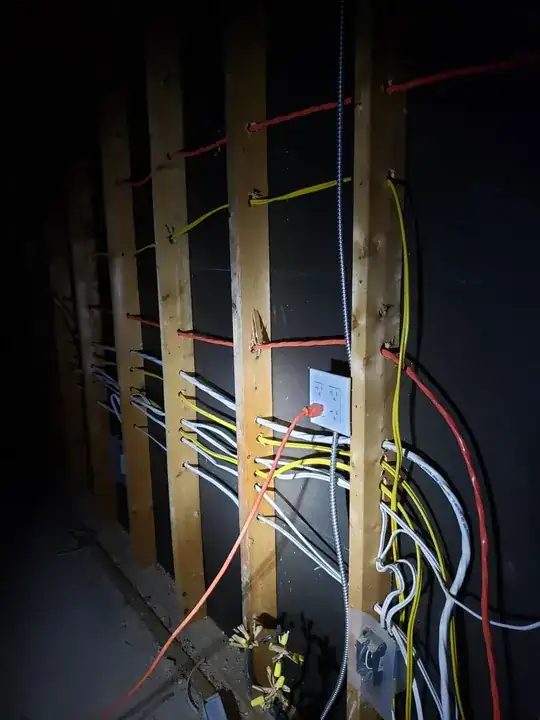
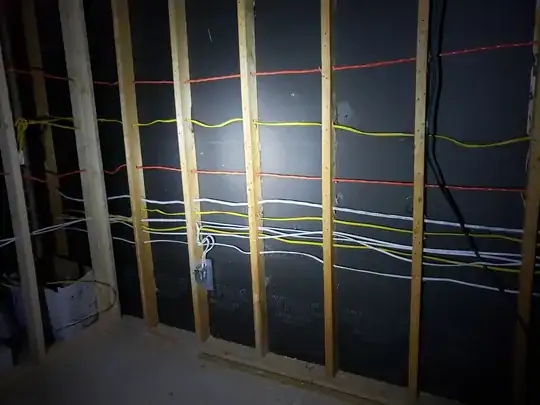
The electrician has created multiple holes in the wall studs to run the new wiring (pls see attached pics). According to him as per code he can only run a single cable through each hole. The studs look a bit like Swiss cheese and we wanted to get the opinion of the forum experts. EDIT: Please note this is an exterior wall

Is he right? Is there not a better way of running the wires? Should wires be protected by metal plates across the studs to prevent damage from screws/nails? Any other things we should be aware of or pointers you can share...
enter image description hereenter image description hereenter image description here

Machavity
  • 23,184
  • 6
  • 41
  • 90
user105375
  • 551
  • 2
  • 9
  • 22
  • 3
    Classic exterior gyprock sheathing... don't see much of that anymore! Presumably there will be insulation going into this wall and the biggest issue there might be to get the batts installed in such a way that all of that cable mess doesn't completely compromise the insulation value. Keep an eye on your contractors when they get to that step. Might consider using loose fill, at least for these section. – J... Oct 10 '19 at 15:14
  • 2
    Actually electric inspections are done through ESA. Electrical safety authority. Get them to provide proof of the electrical inspection as passed. Must be inspected or insurance probably will not cover claims. Aside from that, looks like good work. The no holes in the middle third applys to joists. Holes are centre of the stud and the spacing between holes is 1 1/2" between centre or greater. – user68386 Oct 10 '19 at 23:15
  • I'm not from North America, so a quick sub-question: Isn't an external wall based on this kind of array of studs rather flimsy? Just looking at that thing makes me afraid the house will collapse on my head. (In my country it's either concrete or stone, and no less than 20cm or 25cm thick.) – einpoklum Oct 11 '19 at 07:47
  • 1
    @einpoklum -- it depends on what you're up against. Wood's strength comes from its flexibility, really... – ThreePhaseEel Oct 11 '19 at 11:38
  • @einpoklum If you ever want to take up a demolition job on a timber framed building, try it out sometime. Knocking down a brick wall with a big hammer isn't so hard. With wood attached with structural fasteners, though, it's much tougher than it looks. In OP's area the largest structural stresses are typically snow load (~250kg/m^2 is a normal design load) and the framing is well rated for those conditions. – J... Oct 11 '19 at 14:01
  • @J...: Fair enough, although I didn't say "brick". – einpoklum Oct 11 '19 at 14:03
  • @einpoklum Fair. Insulation is another concern. Timber framing is *much* easier to insulate than concrete or stone. In Israel you don't have to worry about cold, but in Canada when it's -40C outside... well, heating costs can be significant. Wood itself is also a reasonable insulator, so it helps to reduce thermal conduction from the outside. Also, we have a lot of trees. – J... Oct 11 '19 at 14:15
  • @user68386 Depends - ACP contractors don't always need ESA inspections. Typically their work is audited on a sampling basis, so not every job necessarily gets inspected. ACP contractors are usually pretty good, though, because failing an inspection is doubly perilous for them. – J... Oct 15 '19 at 12:15

3 Answers3

22

Looks like a standard install.

You can only run so many wires in a hole without de-rating the circuit capacity.

The holes are set back at least 3/4" from the stud surface, add 1/2" for drywall and you get 1 1/4" the length of the drywall screws. Even if the drywall screw goes into the same line as the hole it isn't long enough to penetrate the wire. If the holes were closer than 3/4" from the surface then they need metal plates.

There are guidelines for drilling studs/joists in non bearing/bearing walls/assemblies. Typically you don't worry about the electrician as their holes are too small and if you do worry you worry about the joists not the studs.

https://www.familyhandyman.com/walls/drilling-holes-notching-and-boring-holes-in-wood-studs/

Fresh Codemonger
  • 12,554
  • 1
  • 18
  • 44
  • Also, most of the strength of a stud/joist is from the timber on the outside of it. Think about how I beams work. – Walker Oct 10 '19 at 13:18
  • @Walker For joists, yes, but studs work in compression along their length, not in tension at the edges (bending). – J... Oct 10 '19 at 14:40
  • 1
    @J... They often fail by bending (eg wind etc) before compression is a real issue. – Walker Oct 10 '19 at 14:44
  • 5
    The metal plates are cheap & easy to install, personally I would just do them and reduce the risk of damage. Other things than drywall screws are likely to be used sooner or later. – StayOnTarget Oct 10 '19 at 15:04
  • @Walker Good point. OP does note it is an exterior wall, so almost certainly is structural. Not sure if there are stricter code requirements in high wind areas for density and placement of such holes? – J... Oct 10 '19 at 15:07
  • @J... I don't know, however in the UK it is not common to build in a way that gets damaged by wind unlike the USA. (Our land is so expensive that most buildings must never be able to fail and damage the building next to it) – Walker Oct 10 '19 at 15:09
  • @Walker I lived in the UK for many years - storms [certainly damage property](https://www.dailymail.co.uk/news/article-2785580/Roof-torn-house-cars-flipped-trees-torn-ground-TORNADO-tears-Derbyshire-town.html) there. I did notice you brits do love a jab at timber construction, though ;) – J... Oct 10 '19 at 15:20
  • @J... A lot can be said for cheap building, and rebuilding every generation as it can work out better then refitting 100 year old buildings. If I had the land in the UK and did not need a mortgage, I would build with a US type timber construction, maybe with double walls to get good insulation. But it needs the land for a good distance between buildings to control fire risk etc) – Walker Oct 10 '19 at 15:25
  • 1
    @Walker I think thats the exact point being made, using that extra land to reduce fire risk and thick walls for insulation is a waste one cannot afford in places where the land itself is extremely valuable compared to the work and materials. – Vality Oct 10 '19 at 17:08
  • @Walker North America already solved this problem - we use fire sprinklers where the houses are close together. – Fresh Codemonger Oct 10 '19 at 17:17
  • 2
    @FreshCodemonger you were not exporting them at the time of the Fire of London. – Walker Oct 10 '19 at 17:21
  • @J... The weird capitalization on that site hurt my head... – Michael Oct 10 '19 at 17:59
  • @Michael Daily Mail...what do you expect! – J... Oct 10 '19 at 18:04
  • @Vality -- you need thick walls for insulation, no matter what you do... – ThreePhaseEel Oct 10 '19 at 22:11
  • @ThreePhaseEel our walls tend to not be all that thick, yet still well insulated. It's a choice of materials as much as anything. – Baldrickk Oct 11 '19 at 09:40
2

You can divide this problem into 2 aspects: First, protecting the lumber integrity when running wires. Second, protecting the electrical wires from damage.

For load bearing studs (there are less stringent standards for non-load bearing), here are the key (U.S. - you can extrapolate for Canada) requirements for 2x4 studs under 10 feet in length:

LUMBER INTEGRITY

  1. No holes or notches in the middle 1/3 of the stud.
  2. Never put a hole and a notch at the same height.
  3. Multiple holes (except 2 side-by-side holes only) must be drilled in the centerline of the stud.
  4. Side-by-side holes require steel plates on both faces.
  5. Holes should not be bigger than 40% of the stud width (max 1 3/8").
  6. Notches should not be bigger than 25% of the stud width (max 7/8").

WIRE PROTECTION

  1. Steel plates should be at least 1/16" thick; plates should be notched flush with the stud edge.
  2. All notches require steel plates.
  3. Holes closer than 1 1/4" to the finish surface of the stud require steel plates.

OTHER COMMENTS

  1. A "better way of running the wires" is to use either armored cable or conduit. Either of these will dramatically increase the cost of this install.
  2. Your electrician is correct in running only one cable through each hole to avoid damaging the insulation with heat (otherwise they must be derated (reduces the current flowing through them), which is impractical).
  3. Holes for the same cable should be at the same level, to reduce wire length and protect the insulation when pulling the wire.
  4. Everyone should replace their aluminium cable and connectors, which cause many structure fires around the world, kudos to you.

REF: Journal of Light Construction

Kromster
  • 170
  • 2
  • 12
jack c
  • 36
  • 3
  • 2
    holes closer than 1 1/4" to the finished surface of the stud - this is wrong. I've seen this printed sometimes, it is 1 1/4" to the finished surface of the wall ( the same length as standard drywall screws ). Lumber integrity - no holes in the middle 1/3 of the stud that's ludicrous. Where is your JLC reference link? No one notches the studs for the steel plates, you'd have people knotch a 1/16" recess into studs to accommodate a nail plate? Walls/studs are rarely within 1/4" plumb tolerances across their height/length, 1/16" - that's for metal parts in machinery. – Fresh Codemonger Oct 10 '19 at 17:26
  • 1
    This is the western wood products association guide to notching and boring. You'll need to create a free account but the PDF is my go to for the notching boring requirements in studs/joists and I post it at my building sites for the trades. http://wwpa.org/docs/default-source/secure/notching-amp-boring-a11.pdf?sfvrsn=0 – Fresh Codemonger Oct 10 '19 at 17:34
  • JLC Field Guide to Residential Construction - A Manual of BEST Practice; Volume 1 - Notching and Boring Studs and Plates p 134. And, Volume 2 - Drilling and Notching p 33 & 35.....You can easily notch a 1/16" plate in a stud with a special tool called a router. Please give me the reference to your "ludicrous" statement. – jack c Oct 11 '19 at 03:25
  • 2
    The ludicrous portion was your lumber integrity #1 - the only thing I see in the field guide that resembles that is not notching or boring the middle third of a joist. Rough framers don't carry routers, electricians are not carrying routers, no one is routering for rough in of electrical. Having a nail plate proud of the surface of framing lumber is well within tolerances of rough framing and just has little to no effect on the drywall. – Fresh Codemonger Oct 11 '19 at 08:14
  • Appreciate all the responses and jack c while we felt replacing the aluminum wiring was the right thing it is an expensive choice. – user105375 Oct 11 '19 at 11:23
  • We are concerned about how the insulation will work now, a point that was highlighted in a comment above. Should the wires be routed differently (through the floors instead? We removed the plaster and old R7 insulation in the exterior walls to upgrade it to something better like R14/15. Not sure how this could work with all these cables. Any suggestions??? – user105375 Oct 12 '19 at 01:51
  • 1
    @codemonger. You won't always have to router out a steel plate I agree, but you may have to in order to stop the drywall from bowing. As for the 1/3 mid section with no holes, if you have any lateral forces, it makes total sense to me, not ludicrous. – jack c Oct 12 '19 at 17:30
0

There is more than one way to comply with the NEC code, but it is too cautious if putting only one 14/2 in a single 3/4" hole.

You can fit two 12/2 nonmetallic sheathed cables through a single bored hole that is fire- or draft-stopped using thermal insulation, caulk, or sealing foam, or where proper spacing is not maintained for more that 24 in. As long as you do this number of conductor/guage or less, there is no de-rating penalty.

So white 14/2's, should be doubled up, as well as any yellow 12/2s. That orange (10g) would still need it's own 3/4" hole regardless. Any */3's would also need their own hole. It's also very possible that installer did everything I described exactly, and we simply cannot see which romex cables are */3s and which are */2 from the picture.

Is it a problem structurally? No, not with 3/4" holes, but less holes are always better structural integrity.

J. M. Becker
  • 493
  • 3
  • 15
  • Something went a little janky with `You can fit two 4 12/2 nonmetallic sheathed cables`. Some sort of typo, copy/paste, incomplete edit issue? `two 4 12/2` is rather confusing. – FreeMan Nov 21 '22 at 17:36
  • @FreeMan, Yea, I grabbed part of the text from another SE answer, cuz I was too lazy to write it again myself.... I think it was trying to say something about number of conductors, but it just complicates what should be a more simple answer. – J. M. Becker Nov 21 '22 at 17:44